
Nathalie Cassée is a block printer and the founder of the Katoendrukkerij in Amersfoort. Having worked in the culture and education sector Natalie wanted to start her own business in 2007 and found inspiration in the craftwork in India. Through collecting highly qualified craftwork, she learned about the richness of craftsmanship in India.
From 2009 Nathalie took lessons in block printing from block printers in India while she was visiting India two to three times each year. Through them, she learned how to print autodidact with natural dyes, diret printing and other techniques like, blue dyeing with indigo, Khari-printing, tie-dye, and bandhani. Besides this Nathalie gained inspiration and education from different designers, artists and blockprinters in France and England to deepen and widen her own craft.
Block printing process
The blocks Nathalie uses are carved in India, where she lets her designs be made. Since 2007 she has traveled to India 2-3 times a year to take back these carved woodblocks, she also gets inspiration from the traditional Indian designs available there and other designers. At times Nathalie also uses the CNC machine she has standing upstairs to carve designs.
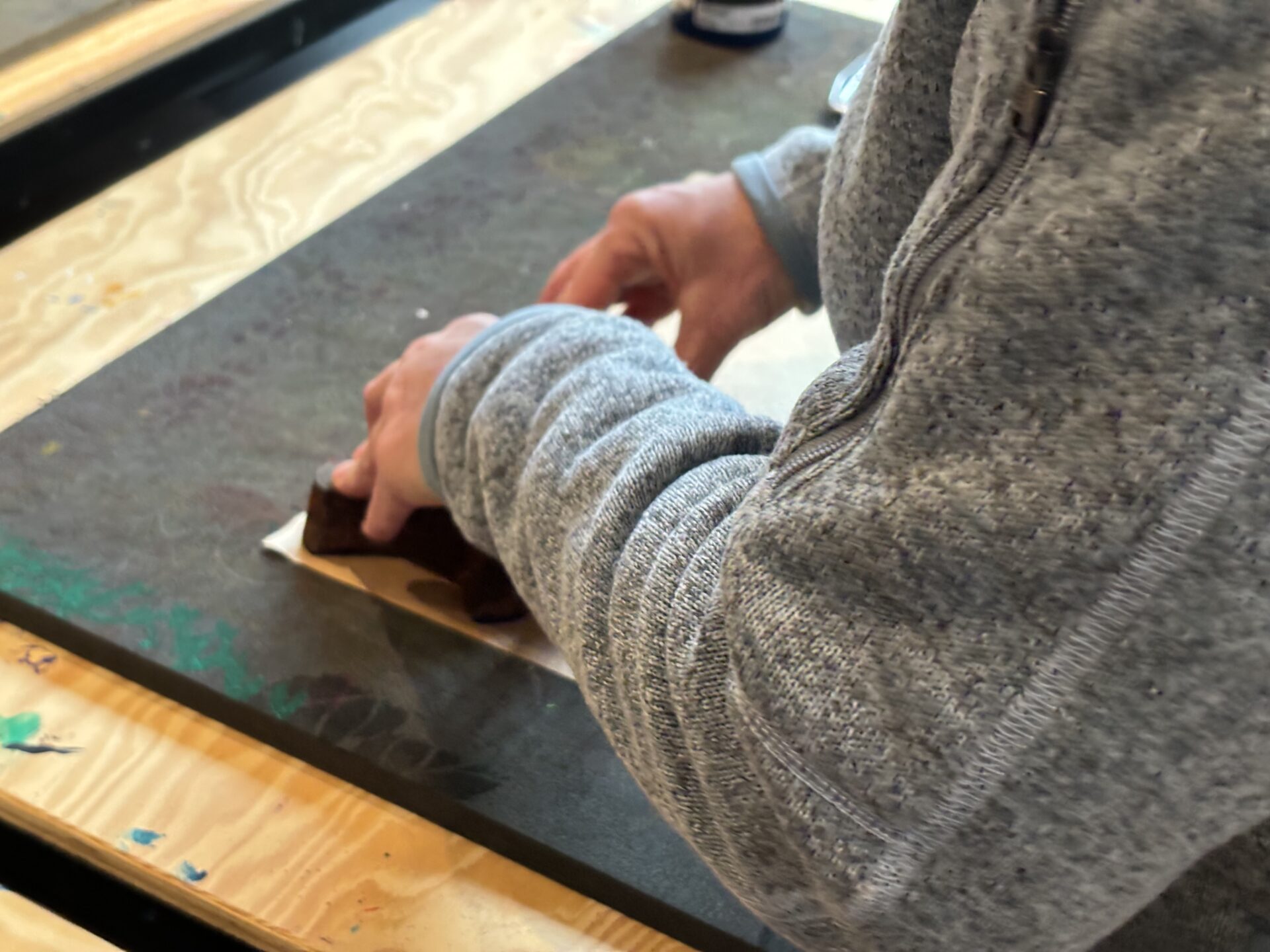
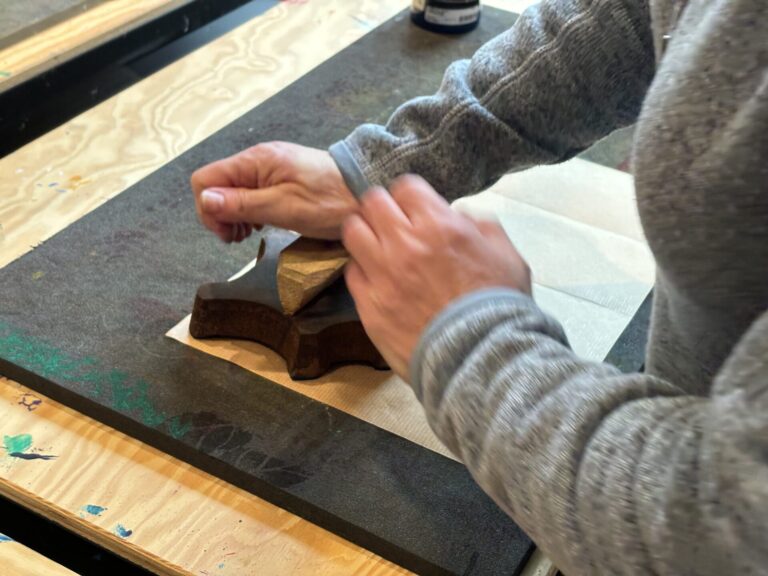
Nathalie slightly adapted the process of block printing, while in India they use a 20-meter-long padded table and a rolling cart that is prepared with a printing cushion with paint It isn’t feasible for her to print this way. Therefore, she brings the paint to the block with a small cushion and puts printing mats underneath the paper.
Block printing always happens from left to right, most printers are ambidextrous and print with both hands. When block printing you must ground your hand on the table, put the block on the paper, and press your energy through the block. Once the block is on the paper, you can’t go back. You must know the block from behind as you can’t see what you are doing, you build this with experience. You have to resist the paper with your hand as you pull the block up. At times, when printing for an assignment Nathalie would measure out the placement of the prints. The paint should be washed off after the printing session is finished, using a small nailbrush and water.
Block printing paints
Nathalie uses different types of paint, such as synthetic environmentally friendly water-soluble paint and natural dye. For each type of paint, a different woodblock is used as the natural dye wouldn’t work on a woodblock that has had synthetic dye on it. Nathalie has her own 36 m2 dye garden at the backside of the workshop and wants to take it to the next level. There are also workshops given at the Katoendrukkerij regarding natural dyeing processes. Furthermore, Nathalie explained the technique of printing with natural dye and preparing the fabric so it would stain came from India to the Netherlands. Before that only the whole garment could be dyed, but not local prints.
History and colonial ties
The block designs came over from India to the Netherlands. In India, there is a design tradition of 5000 years, designs and symbols have different meanings attached to them. When these prints and block printing techniques came over to the Netherlands we took over the designs but left the symbolism behind. For example, the paisley symbol, named badam in India, came to the Netherlands through Dutch East India company trade. When the fabrics became a commodity, they were reproduced in factories in Paisley Scotland, effectively changing the name of the symbol and causing people to forget that the symbol is originally an Indian symbol.
Amersfoort was the first place in western Europe where the craft of block printing was established through the trade of the Dutch East India trading company. It intersected with the trade with Indonesia as fabrics were traded for spices. Later, it became a commodity to the Dutch themselves and they started trying to reproduce the fabrics. This is how block printing established itself in Amersfoort. The imported technique had a big impact on the creation of traditional Dutch fabrics and their designs. Read more on this in our article on De Volmolen.
Knowledge transmission
Nathalie observes that there isn’t a lot of education on crafts in the Netherlands: they see crafts as a skill, not a profession, unlike in France or England there isn’t a status for craftmanship you can hold within the Netherlands. However, she is working on adding to the education of crafts for elementary school students and vocational education. As such she organizes workshops in blockprinting for elementary school students and voortgezet onderwijs (dutch high school) students. Nathalie sees the effect the workshops have on children: when teaching a child who usually doesn’t do good in school but finds out they have a talent for the creative process and designing they start to feel different about themselves, more confident. However, these qualities are not always appreciated at school.
De Katoendrukkerij is also available for internships, exchanges, or education in collaboration with or for students from vocational education. Nathalie would like to apply for the ‘fonds meestergezel’ that subsidizes around 25000 euros to train someone in her craft. Through this, she hopes to transmit the knowledge and hand over the workshop to the new generation. While the Netherlands would be too small for 10 block printers (at her scale), it would be nice to have 2 or 3 to keep the craft going.
When teaching, Natalie lets people observe first how she does the printing. Stating that learning a craft isn’t cognitive but observant. Furthermore, it is a 2-way street, you also reflect on your work as you teach.
Nathalie finds it important to not only give workshops on the craft itself and teach block printing techniques, but also create a space for extracurricular programs of history. These emphasize the connection and heritage of the craft and where it came from. For example, she invited the Dutch Tradepost Heritage Network together with the Rijksdienst to visit de Katoendrukkerij. She also notes that nowadays it seems that people forget this is a craft established in the Netherlands. While it is recognized abroad – musea in France mentions Amersfoort by name when talking about woodcarving – within the Netherlands there doesn’t seem to be any recognition of the craft.
Reach out
If you are inspired by Nathalie and the Katoendrukkerij, find out more via:
https://www.dekatoendrukkerij.nl/
Why is this relevant?
Contributed by
Interview