
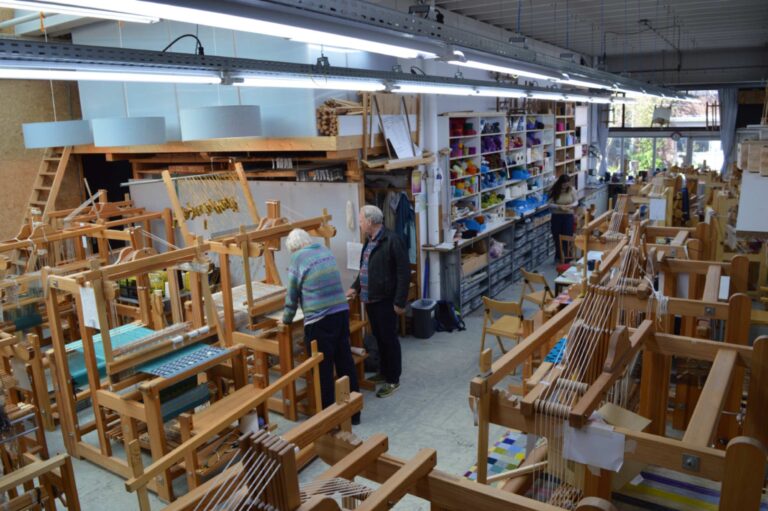
Sytze Roos is a weaver based in Amsterdam. He has been investigating woven fabrics since he was two years old, when he would look at curtains and following the threads in the fabric. Inspired by this, he started embroidering when he was four years old and moved on to weaving when he was around 12 or 13. When Sytze decided to follow the weaver’s profession his family would have rather seen him do something else. However, Sytze took this as inspiration to keep going with his weaving journey. Sytze lived in multiple European countries for over 30 years, deepening his knowledge of different weaving techniques and developing his skills. Now, Sytze runs a weaving academy in Amsterdam where he hopes to pass on his knowledge of weaving to a new generation of professional weavers.
The Fourth ‘Grondbinding’
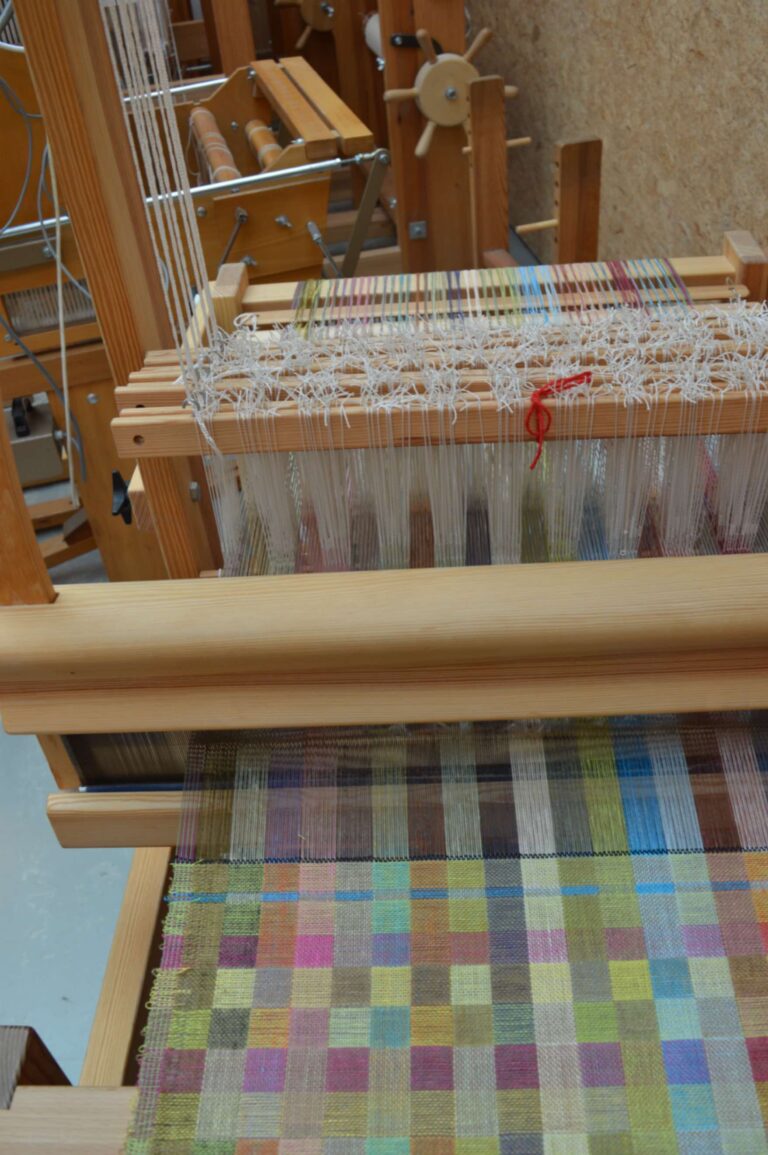
While living in Norway Sytze noticed that weaving as a technique could also be developed further. He became interested in the ‘art and craft’ of weaving – delving deeper into the craft and technique to create something new. At the start of the 90s Sytze began the development of the fourth ‘grondbinding’1. Within weaving there are countless possibilities of binds for the weaving machine; currently three ‘grondbindingen’ have primarily been used. These three bindings have continued to be used over time because people thought everything could be woven with them. Because of this notion, people stopped developing new weaving techniques. Meanwhile, partly because of industrialization, many other ways to bind up a loom have not been saved and were lost over time. These are bindings that would normally be passed on within the family. This new way of weaving that Sytze discovered can produce patterns that don’t repeat themselves but are always a little bit different. Sytze mentions that weaving is mass-production, because patterns are always repeated and, according to Sytze, that is mass-production. Once you have set up your loom, you weave the same type of pattern throughout repetitions for a couple of meters. However, through a digital weaving machine and the fourth ‘grondbinding’, there is the ability to create unique pieces of weaving, where every time the pattern is slightly different.
What is in a tool? Analogue versus Digital
Though digital weaving creates the possibility to create unique works of weaving, most people don’t view digital weaving machines as proper weaving. Sytze mentions people are not ready for it. Most people who are just stepping into weaving envision themselves weaving on the more ‘traditional’ (analogue) looms. People view the digital machines as distant, a technology which is unclear to grasp; they assume the machine removes the craftmanship from the practice of weaving. However, Sytze’s opinion differs, he believes that through digital weaving we can go back to hand weaving; not having to be bound by the repetitive patterns we need to follow on an analogue weaving machine but instead be able to change course in the weaving pattern at any given moment and time.
In this sound clip you can hear the sound of a shaft loom being used:
Reach out
Are you inspired by Sytze’s story? Contact him through his website www.weefacademie-sytzeroos.nl.
Why is this relevant?
Sytse’s story reveals the misconception of technology people have when starting with traditional crafts. It showcases the ability of technology to create new and free designs without repetition. This challenges our conceptions of ‘traditional’ and ‘modern’ within traditional crafts. Sytze’s story also showcases the undermined quality of crafts, and how innovation within craft processes can still be present.
Contributed by
Interview
References
1: Grondbinding’; The way threads are tied up into the loom.↑