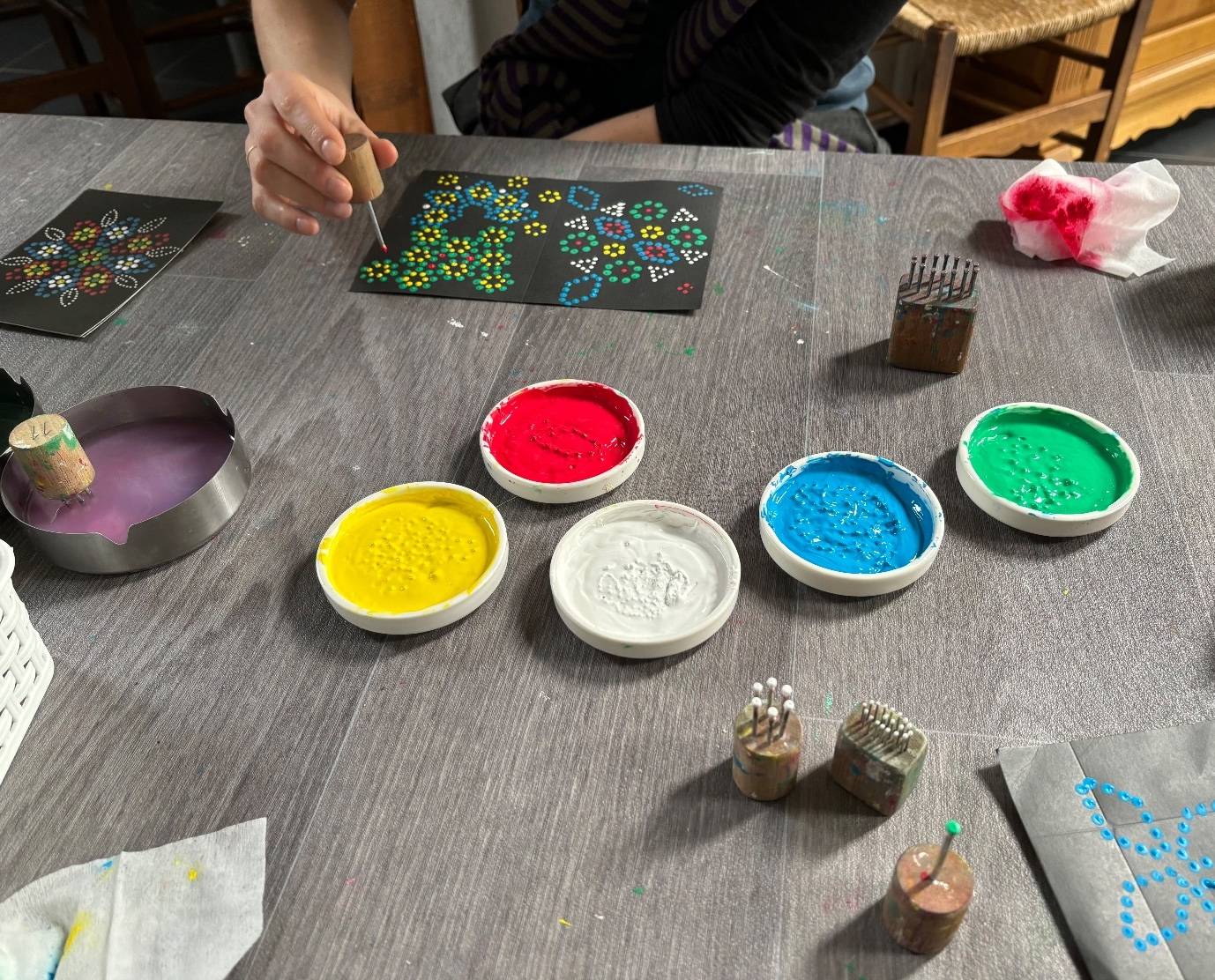
Within Staphorster dotwork, every craftperson has their own signature. ‘Drukkers’1 use and create their own stamps, have their own preference in pattern usage, and their own embodiment of the craft – some put importance on precision while others might focus more on the balance of colour. Throughout this, the paint used within the dotworking process creates a unifier across all works. The usage of good paint is essential to create the characteristics of the traditional dotwork on fabric. The paint has to create a drop-like shape on the fabric, be fluid enough to adhere to the fabric without being absorbed by it and have a elasticity to it so the dots don’t snap and create cracks or break off, also called ‘knappen’ by ‘Staphorsters’2.Ideally the dried dots are characterized by a slightly shiny finish; however, the paint used isn’t standardized which causes these characteristics to be lost at times.
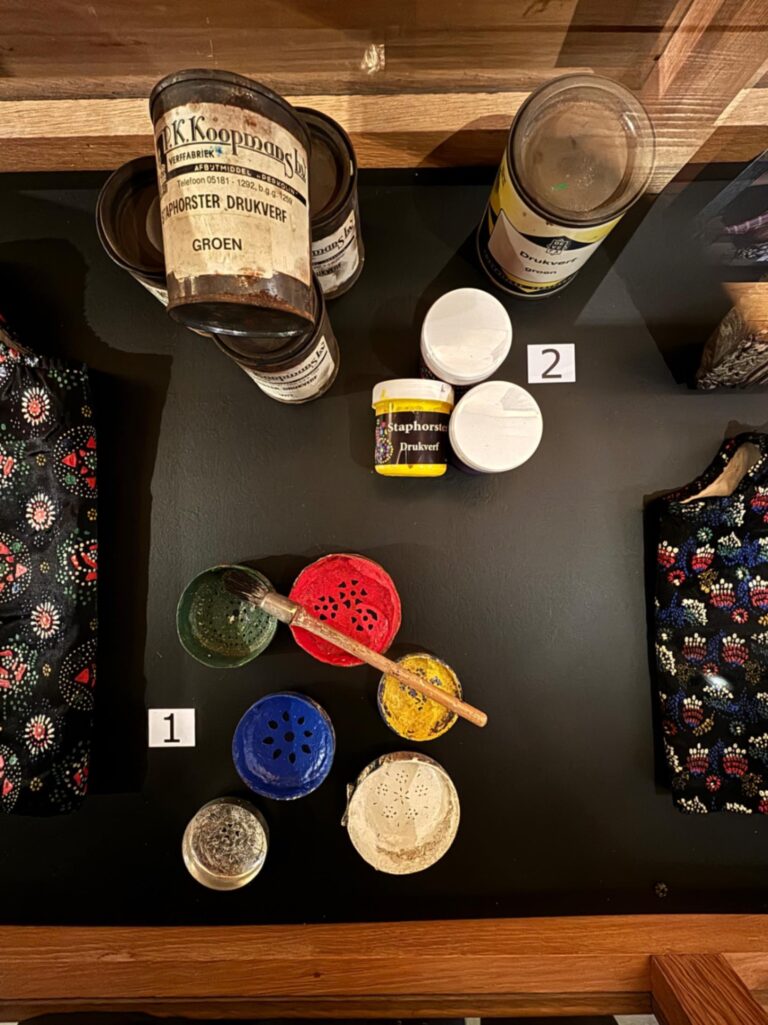
There was a secrecy around the making of the right paint. In the past there was a powder that had to be mixed in different way and substances to create the right paint. When dotwork was first introduced, the paint used was a one most likely made from petroleum. While paints used to be made from natural materials like linseed oil3, with the introduction of petroleum at the beginning of the previous century most paints started to be produced synthetically with petroleum which was a cheaper and quicker production process.4Throughout the years, some of the products that were used in the original dotwork paint started to go out of production likely due to the demand for more sustainable products. This resulted in the dotwork paint running out, endagering the continuation of the intangible cultural heritage of Staphorster dotwork. Because of this the need for new ways to create the dotwork paint arose. However, the making of the paint is a craft in itself; a ‘drukker’ reflects that through her year-long experience she is able to feel the right balance in ingredients when making the paint, as she adds a bit of varnish or glossy paint to create the correct colour and shininess in the dots.5 Others recall having to go to certain experts when the paint didn’t have the right characteristics. These experts would add different substances to create a correct consistency in the paint. The processes of making the paint were mostly kept secret or weren’t passed on and written down, creating a lack in knowledge for the current ‘drukkers’ in how to continue and preserve the intangible cultural heritage of their craft.
The Staphorst Stipwerk Stichting is now looking to create a new version of the dotwork paint, one that follows a known recipe and is sustainable in order to provide a essential building block to keep the heritage of Staphorster dotwork alive. The journey towards this paint isn’t easy as every charactaristic of the paint has to be taken into consideration. When the paint is too thick it might create little spikes instead of the characteristic dome-like dots. When it doesn’t have elasticity the paint might crack when dried. And it can’t be absorbed too much into the fabric because it wouldn’t create the 3D dot effect. In addtion, It should be water-fast and washable and above all, it should be glossy. In a latest test of a new paint created in cooperation with a paint factory the paint dried almost perfectly, but lost the glossiness. However, the ‘drukkers’ don’t want to compromise on their own paint standards. If they did so, the intangible cultural heritage of the paint and the dotwork itself wouldn’t be protected. The story around the Staphorster dotwork paint visualizes the need for innovation and open-source practises in the protection of intangible cultural heritage but also how sustainability goals can endanger recently established heritage practices.
Why is this Relevant
The story around Staphorster dotwork paint shows the importance of open-source knowledge and the need for innovation. Within the Hacking the Machine pilot we try to create new sustainable natural paints, through this research we hope to help bring sustainable paint alternatives to the Staphorst community.
Collected by
Interview (verbal), research.
Sources
-
‘Drukkers’; The term used in Staphorst for craftspeople specialised in Staphorster dotwork. ↩
-
‘Staphorsters’; people who are native to the village of Staphorst. ↩
-
Linseed oil is oil derived from flax seeds. ↩
-
“Circulair Verven,” PBL Planbureau Voor De Leefomgeving, n.d., https://themasites.pbl.nl/o/circulariteit-in-de-bouw/rigo/. ↩
-
Dirk Kok, Kleurrijk Gedrukt. Oorsprong en Ontwikkeling van het Staphorster Stipwerk. (LK Mediasupport, 2014), 181. ↩