
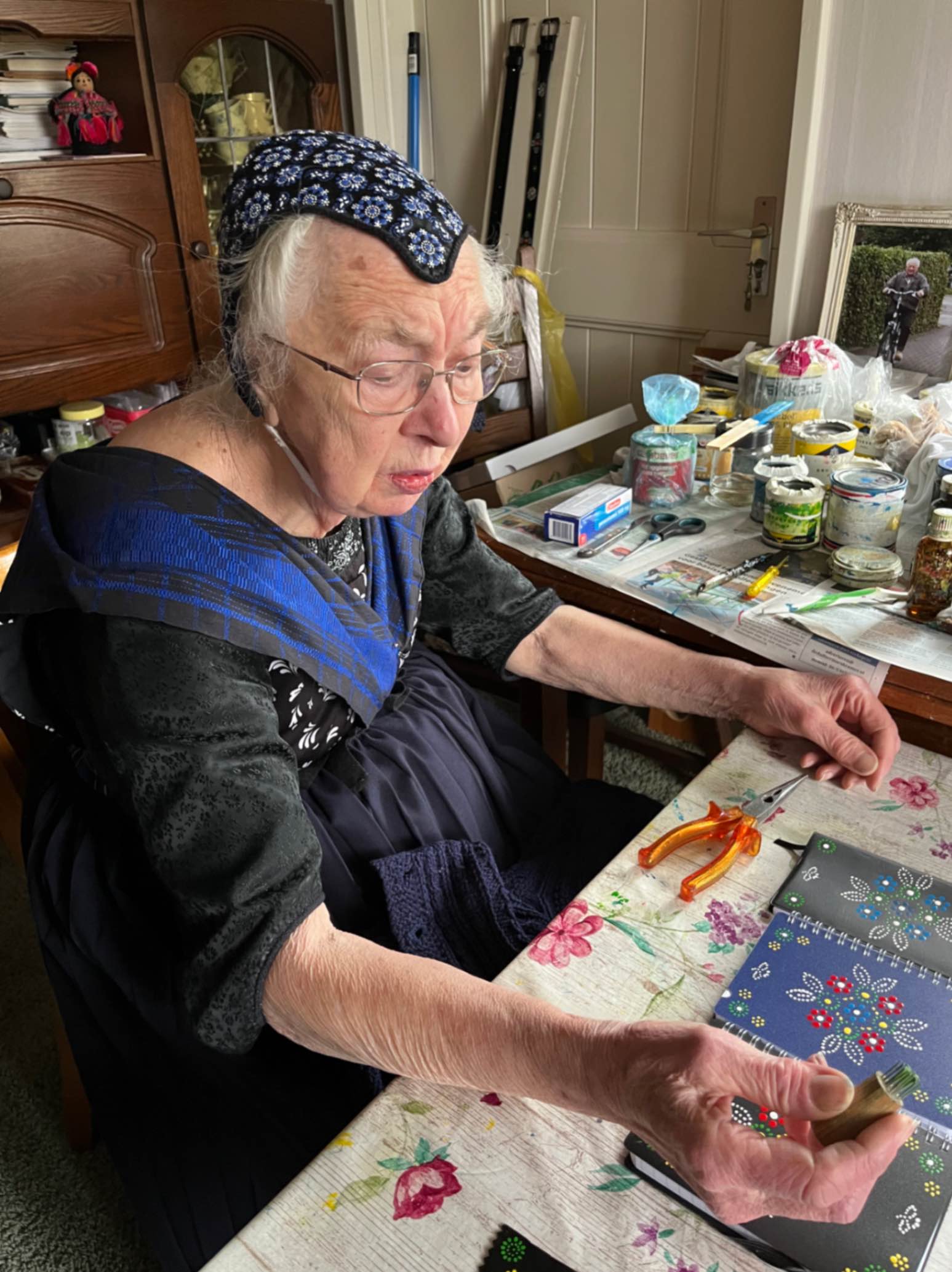
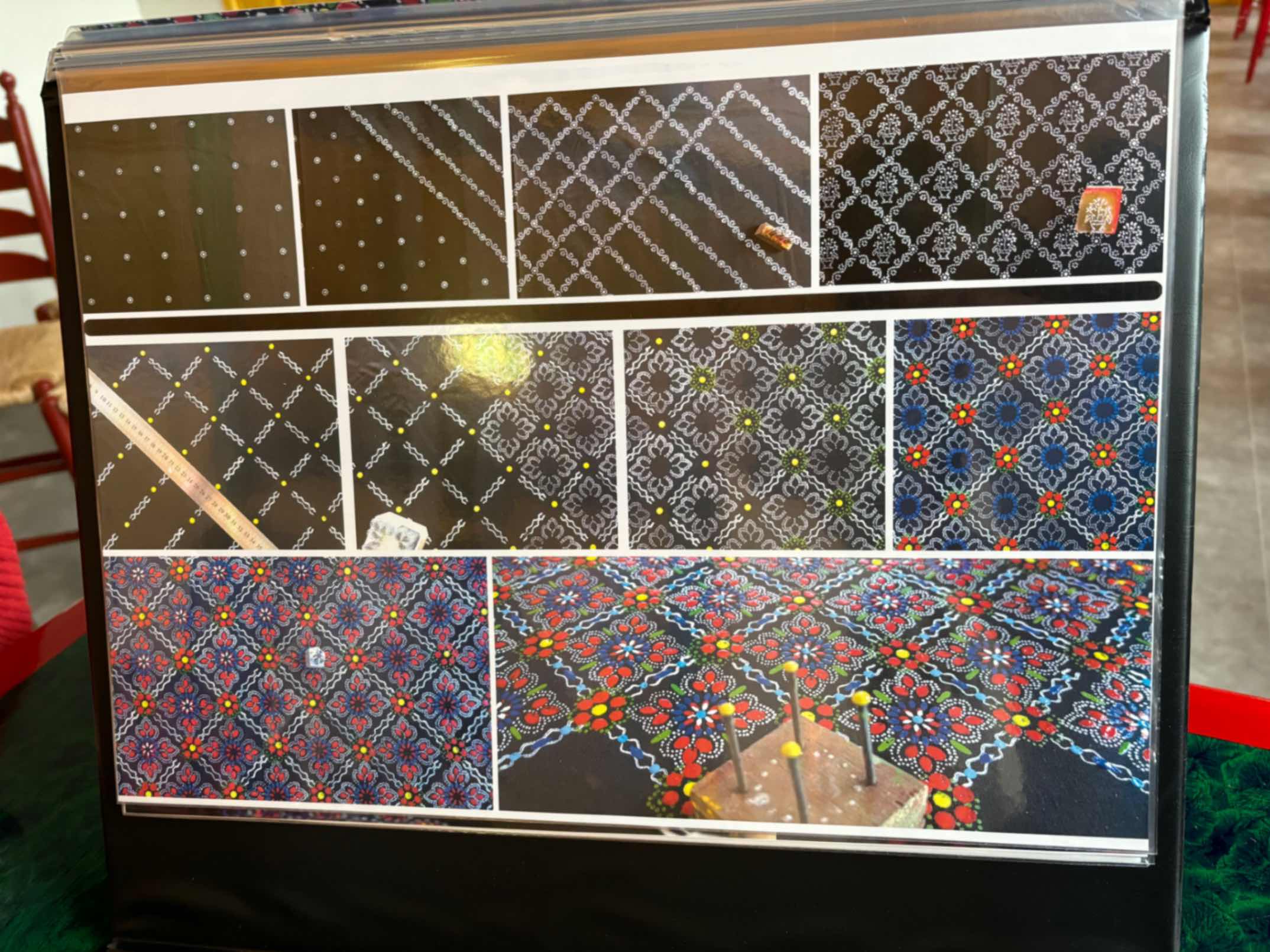
Starting from the left-hand corner, stamps are slowly and carefully placed on black fabric, touching the fabric slightly to create the typically round dome-shaped dots of paint. With the help of a template, the craftsperson creates a diamond-shaped outline by placing single dots on the fabric after which the pattern is filled colour-by-colour and shape-by-shape creating a symmetrical pattern throughout.1 Carefully paying attention to the colour combination while working, aiming to achieve the perfect balance of colours in line with the traditional Staphorster dotwork fabric. Staphorster dotwork has been considered Dutch intangible cultural heritage since 2014 and is embedded in the recent history of Staphorst, a village in Overijssel in the Netherlands.
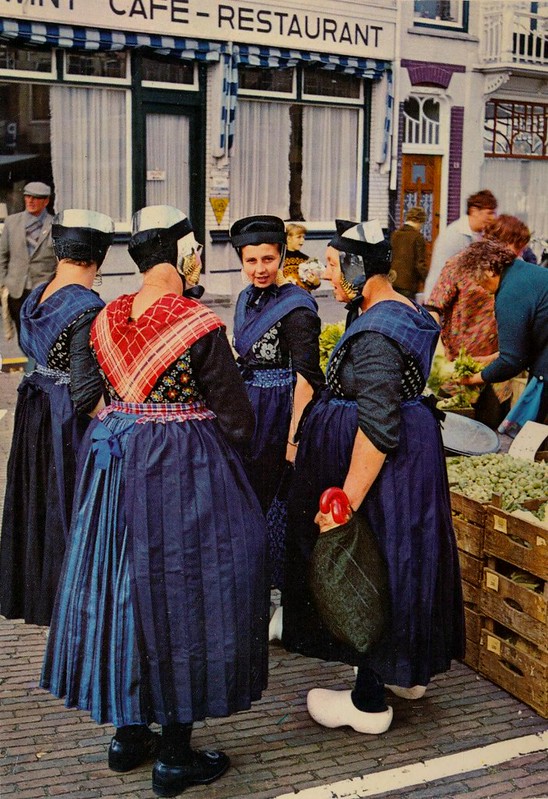
Staphorster dotwork started to make its introduction in the traditional costume of Staphorst at the beginning of the last century. Frans Vloedgraven (1873 – 1953), a resident of Staphorst, became inspired around 1900 by a farm lady wearing block-printed fabrics at a market in Meppel, wanting to bring these back to Staphorst and introduce these fabrics for the traditional costume of Staphorst.2 Frans came in contact with Palthe, a firm in Almelo that created these fabrics. When Pathe stopped the production of these fabrics a few years later, Frans, took over the blockprints and started the blockprinting process himself.3 These blocks and the prints inspired the women of Staphorst to create their own stamps by putting pins and nails in cork. Staphorst being a poor village, the introduction of the craft brought new possibilities of income for these women who were either widowed or trying to keep a household standing. Through this, dotwork became a staple in the traditional costume of Staphorst, as the ‘muts’4 and ‘kraplap’5 started to feature the dotwork fabrics.
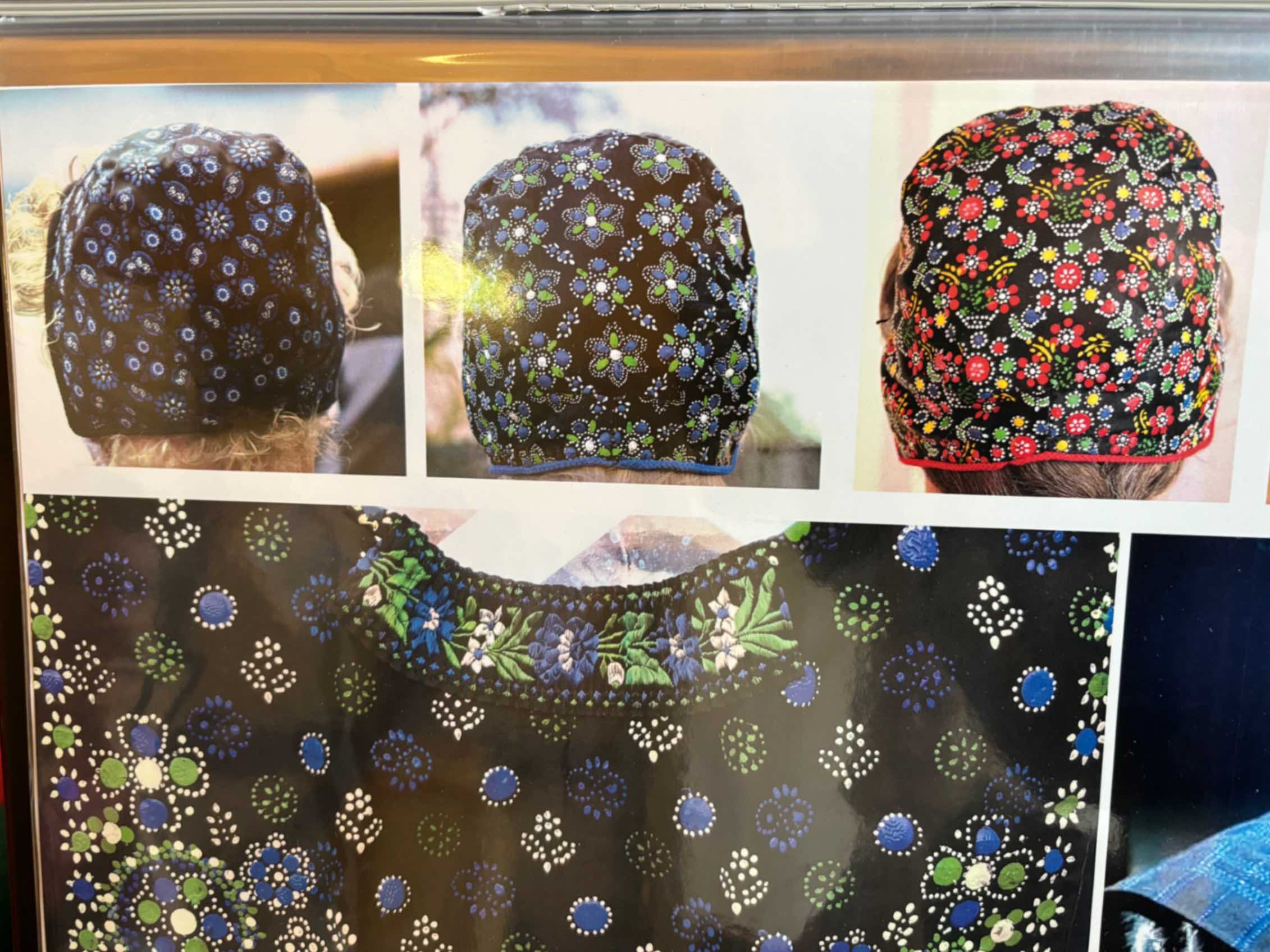
With the craft not being passed on to younger generations and the disappearance of traditional clothing from the street view, dotwork started to see a decline in practitioners. This is also reflected in the diversity of dotworked traditional clothes currently worn in Staphorst. While there isn’t a deeper meaning behind the patterns used within dotwork, the colour combinations relate to the state of mourning one is in. When one isn’t in mourning the colours red, yellow, blue, green, and white are used. In light mourning, when a nephew or neighbour passes away,green, blue, and white paints are used. In heavy mourning, when a husband passes away, the ‘kraplap’ will feature white and black, and the ‘muts’ blue and white. Often, after a husband passes away a woman stays in mourning for the rest of her life. Without younger people wearing the traditional costume, and generations growing older and passing away, the colours red, yellow, and green slowly start to disappear in the traditional clothing still worn.
The story of Staphorster dotwork illustrates how new crafts can be influenced and inspired by historical innovations such as block printing. Koob Vloedgraven, the brother of Frans Vloedgraven continued the process of dotwork using the block printing method, enabling a possibility to print bigger surfaces and create more detailed prints.7 ‘Staphorsters’8 called these block printed fabrics ‘mechanical’ rather than it being a handcrafted process, since a machine was used in the unrolling of fabrics.9 These mechanical dotworked fabrics were mostly used for the ‘kraplap’ in heavy mourning since they were deemed more plain than the dotworked fabrics by hand.10 The blockprinting process in itself can, within history, also be seen as a mechanization of hand-painted fabrics. This shows that mechanizations can create and influence new craft processes.
The intangible cultural heritage of dotwork is being endangered by a declining population of ‘drukkers’11 and those who wear the traditional costume. There is also a concern about the sustainabilty of the paint used for dotwork (see Staphorster Dot-Work Paint). In recent years ‘Staphorsters’ have worked on keeping the tradition of dot work alive, causing the dotwork to appear on non-conventional items geared at tourism, like clogs, and coffee filter-holders.12 In an aim to preserve the more traditional process of Staphorster dotwork on fabric, the Staphorster Stipwerk Stichting was established. Staphorster dotwork illustrates the fragility of intangible cultural heritage and the importance and difficulty of safeguarding heritage processes.
Why is this relevant
At the start of February 2024 the pilot ‘Hacking the Machine’ of Tracks4Crafts visited Staphorst to learn more about the Staphorster dotwork craft. This visit created more insight into development of the haptic machine.
Collected by
Interview (verbal), research.
Sources
-
Dirk Kok, Kleurrijk Gedrukt. Oorsprong en Ontwikkeling van het Staphorster Stipwerk. (LK Mediasupport, 2014), 65. ↩
-
Kok, 29. ↩
-
Kok, 29. ↩
-
‘Muts’; a cap worn by women in the traditional clothing of Staphorst. ↩
-
‘Kraplap’; a square piece of fabric that covers the bust and back in the traditional clothing of Staphorst. ↩
-
“pc Staphorst markt j 70-80” by janwillemsen is licensed under CC BY-NC-SA 2.0. ↩
-
Kok, 131. ↩
-
‘Staphorsters’; people who are native to the village of Staphorst. ↩
-
Kok, 137. ↩
-
Kok, 137. ↩
-
‘Drukkers’; The term used in Staphorst for craftspeople specialised in Staphorster dotwork. ↩
-
Kok, 21. ↩