

Riley Cox is an innovative multidisciplinary artist from the United States. Growing up with a mother who is a weaver, Riley was surrounded by floor looms and developed a profound appreciation for weaving from an early age. She furthered her passion by studying textile and sculpture at Maryland Institute College of Art where she gained experience in maintaining and using a TC2 digital jacquard loom. She is interested in combining her love for new technologies and science with textiles, craft history, and biotechnology. Riley is also a recent graduate of the Fabricademy at Waag Futurelab where she developed an open-source jacquard loom.
The open-source jacquard loom
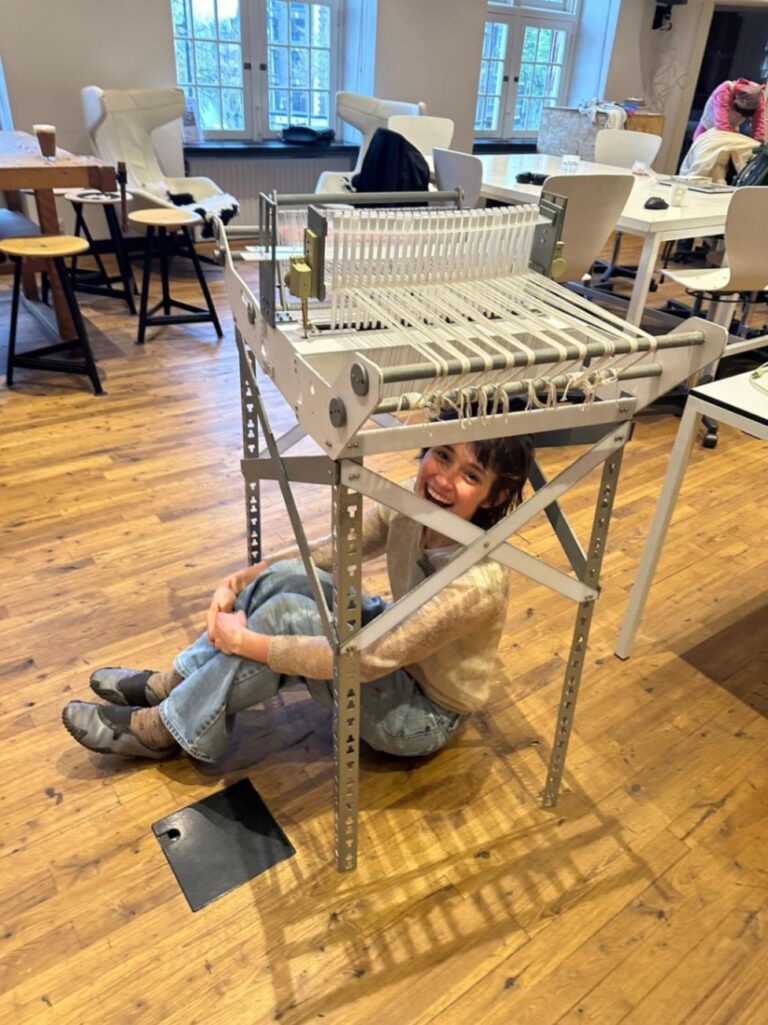
Riley’s latest project is an open-source version of the jacquard loom, designed specifically for weavers to create intricate images and patterns. Digital jaquard looms are often inaccessible to recent graduates from textile studies and independent weavers. To address this, Riley looked back into history, drawing inspiration from pre-computer jacquard looms that used punch cards—a method reminiscent of a music box mechanism.
Her modernized version of the loom incorporates an Arduino (an open-source computer platform), and motors lift and lower strings of thread. These strings are connected to pegs that fall into punched holes; a peg falling into a hole dictates whether a thread is lowered or not. This translates the binary system of punch cards into physical weaving patterns. This approach allows weavers to design their own punch cards and create patterns without the need for complex electronic knowledge. The loom is designed to be customizable, with adjustable height and extendable arms to accommodate different weavers’ needs.
Riley’s project is not just about creating a tool; it’s a statement about ownership and accessibility in the weaving community. The designs for the loom are available to download from Riley’s github page. By making the design open source, weavers are invited to modify and improve the loom, fostering a sense of authorship and community.
Mixing technology and traditional crafts
The history of the loom is deeply intertwined with the history of computing, with early jacquard looms playing a significant role in the development of binary computing systems and mechanized production. Understanding modern digital weaving machines can be difficult; this can create a feeling of distance and dissonance in the crafting process. However, by revisiting the punch card system, Riley created a way to better connect to the process of jacquard weaving while fostering a better understanding of this weaving process. This offers a new way for craftspeople to engage with their craft, using technology to enhance rather than replace their skills.
Riley believes that using craft as a method to develop a more intimate understanding of technology can lead to more meaningful and sustainable innovations. By viewing tools as collaborators, she fosters a symbiotic relationship between the weaver and the machine.
Reach out
If you are inspired by Riley’s story please reach out to her through;
https://www.rileycox.net
https://www.instagram.com/marbled.rye/
If you would like to read more about her work at the Fabricademy;
https://class.textile-academy.org/2024/riley-cox/
Contributed by
Interview.