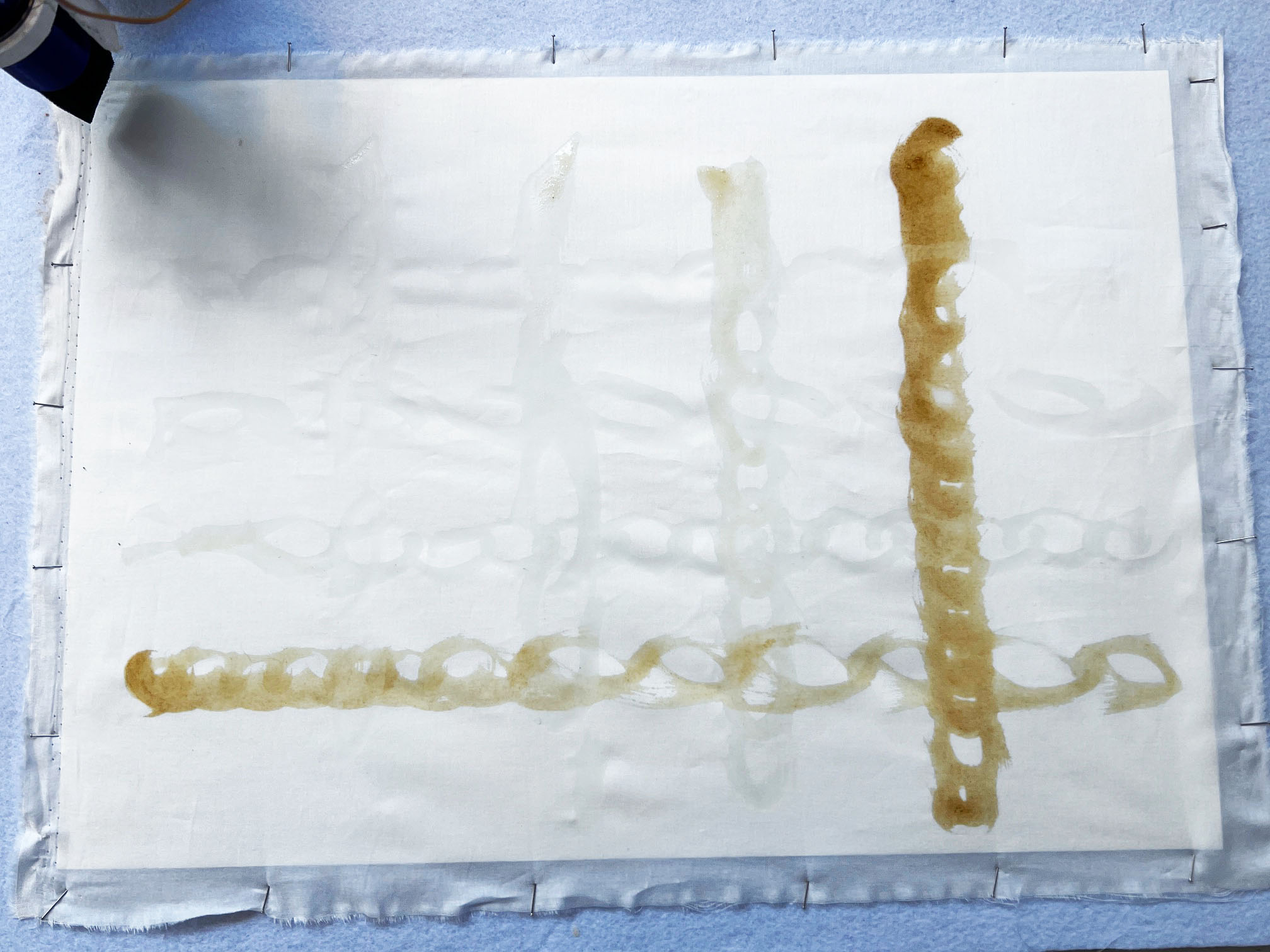
Is a technique in which one or more varieties of thickened mordant pastes are applied to cloth, fixated via immersion to remove the thickeners and then dyed in an immersion dye bath. For general understanding of how this process relates to the other printing techniques, please refer to Principles of bio-based printing on textiles and General techniques and processes.
The solutions
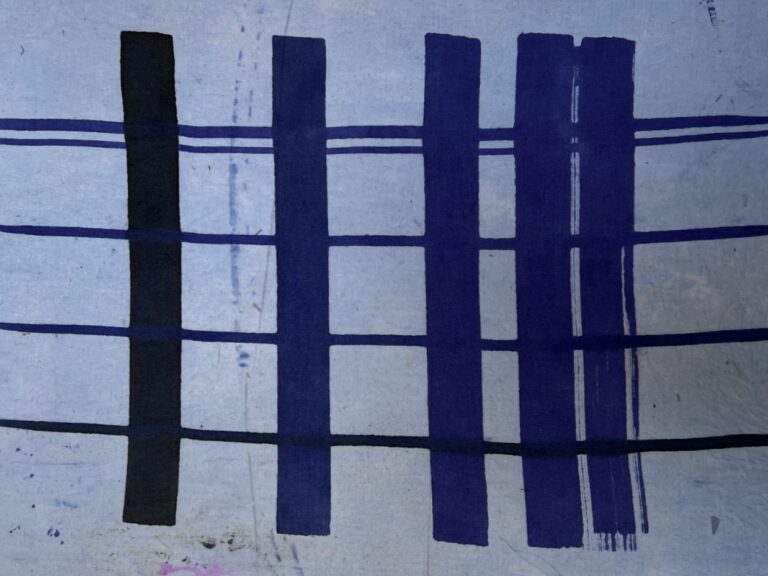
To create a variety of mordant printing solutions, a mixture of varying percentages of aluminium-based mordant and ferrous-based mordant are being created as follows:
- solution 1 – 100% aluminium-based mordant
- solution 2 – 90% aluminium-based mordant & 10% ferrous-based mordant
- solution 3 – 70% aluminium-based mordant & 30% ferrous-based mordant
- solution 4 – 100% ferrous-based mordant
The aluminium-based mordant is either crafted departing from aluminium sulphate, or directly using the acetate form, which is the preferred when printing on cellulose-based textiles. When working from the sulphate, it needs to be dissolved in a mild acid solution, such as vinegar or citric acid, and then neutralised with a basic, to form a neutralised acetate. The strength of aluminium to acid is of 10%. The amount of alkali/basic will depend on the strength of the acid used. By using ph-strips, we can measure along the way to ensure the ph is back to 7 and is therefore neutralised.
Similarly, for the ferrous-based mordant, we follow the same logics. With exception for the strength, which will require a maximum of 4% of ferrous-sulfate.
Solutions are first created independently, then mixed into the 4 solutions ratios and then thickened just before use. In terms of thickening agents gums and starches can be used, our preference goes to 1% of total solution Guar gum and is valid for both solutions. Gum tragacanth is a great alternative, when using only aluminium-based mordants.
The process
- Scouring of cloth (when cellulose based)
- Preparation of mordant pastes – the 4 solutions
- Printing, deposition of mordant paste in place
- Fixating (drying, immersion dunging)
- Immersion bath dyeing
- Rinsing
- Clearing of background
Fixating
Is executed in 2 steps, drying and immersion dunging. Thorough drying of the textile of at least 1-2 days is required. The textile is ready when no smell is left behind on the printed areas. The dunging is traditionally done with dung, hence the name, to bring back the same process we use a cup of bran in 10 litres of water, with an addition of a table spoon of chalk to finalise the neutralisation of the solutions. The fixation process will ensure that the mordants wont leak into the water and affect one another.
The dye bath
For the dye bath, any natural mordant-dye can be implemented, the most effective are ones that do not have any affinity with unmordanted cloth.
In the experiments of the hybrid encounters, examples with a number of mordant dyes are to be found.
example: a Logwood dye bath was used at ph 7, the background was cleared with a mild citric acid and then neutralised with chalk again.
Additives & ph-levels: A number of additives and ph-modyfiers can be used in the dyeing process, depending on the dye in use. we suggest to experiment with chalk, cream of tartar, soda, citric acid, etc
example: onions dye bath was used at ph 9 through the addition of soda, the background was cleared with a mild citric acid, without a subsequent bath of chalk or soda.