
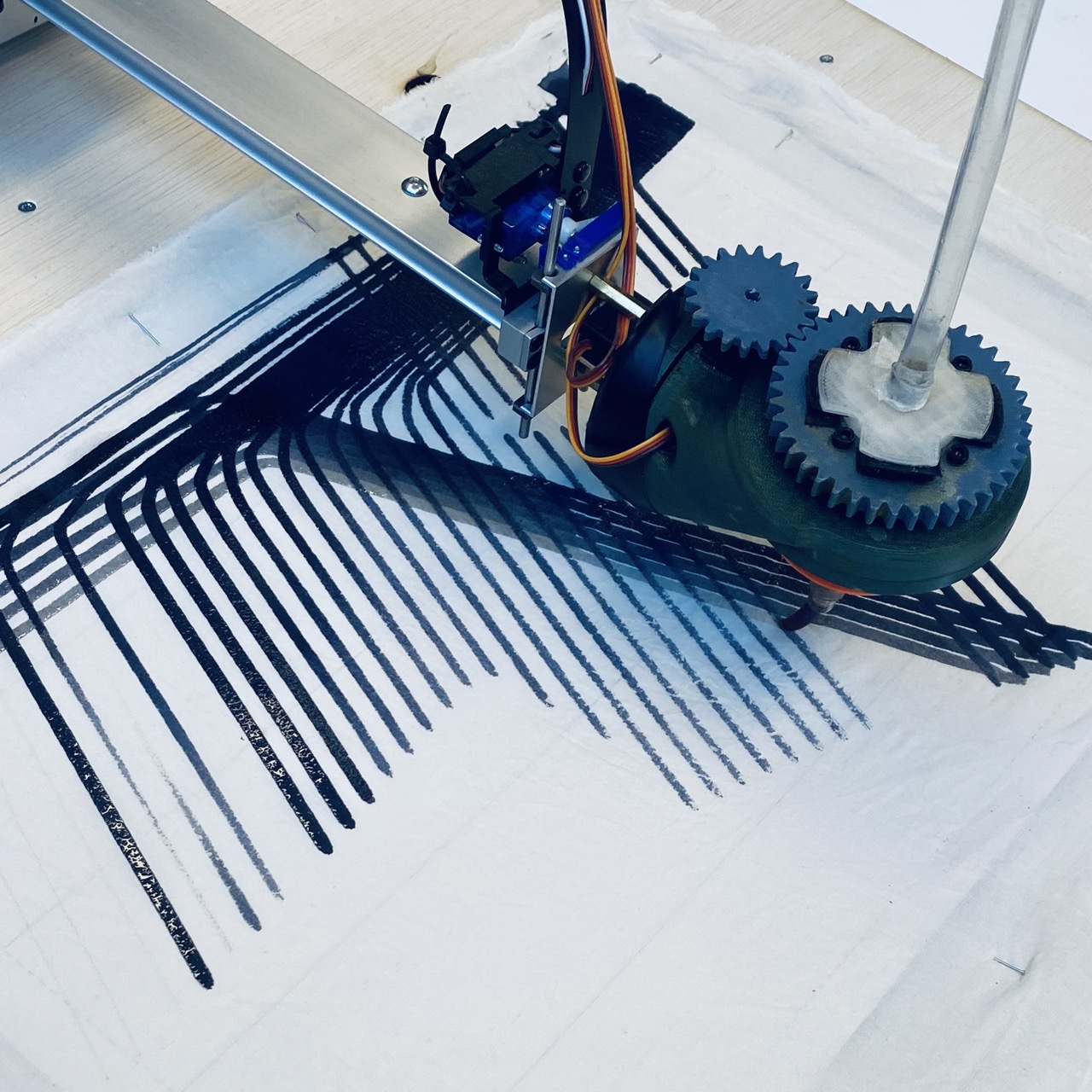
Ferrous mordant printing in combination with tannins is a technique to produce a black and white stable print. For general understanding of how this process relates to the other printing techniques, please refer to Principles of bio-based printing on textiles and General techniques and processes.
The process
The cotton or vegetal fiber cloth is firstly prepared as usual, by washing and scouring. Separately, a solution of ferrous sulphate is prepared, in the form of ferrous acetate.
Once the cloth has undergone the three steps of preparation, it can be printed with ferrous mordant solution.
- Scouring of cloth (when cellulose based)
- Seizing of cloth
- Preparation of mordant paste
- Printing, deposition of mordant paste in place
- Immersion dye in tannin rich solution
- Fixating (drying, immersion dunging)
- Dyeing
- Rinsing
Fixating
Is executed in 2 steps, drying and immersion dunging. Thorough drying of the textile of at least 1-2 days is required. The textile is ready when no smell is left behind on the printed areas. The fixating in this case is done with a light bath of chalk to finalise the neutralisation of the solution. The fixation process will ensure that the mordants wont leak into the water and affect one another.
Dyeing
Lastly, the cloth is dyed with a tannin rich material, such as turkey oak galls, knopfer galls, myrobalan, sumac, bark etc.
Notes about seizing:
Inspired by the traditional Kalamkari blackwork we have adapted their workflow of using Buffalo milk for seising the fabric, by implementing cow milk, an over-abundant material in The Netherlands.
This fundamental step in the process ensures that the iron mordant paste will not bleed over the fabric, but rather hold its outline while drying. This is essential when working on thin blackwork lines.