Glossary

A collection of terms surrounding the pilot ecosystem. It explores current and past meanings to contextualise the value of craft in today’s reality. It’s a multidisciplinary reference – it’s important that people from different backgrounds and disciplines understand each other’s language within these processes.
A

Artisan

An artisan is a skilled craftsperson who makes material objects partly or entirely by hand.

Ambacht (NL)

Ambacht is the dutch word for craft.

Axidraw

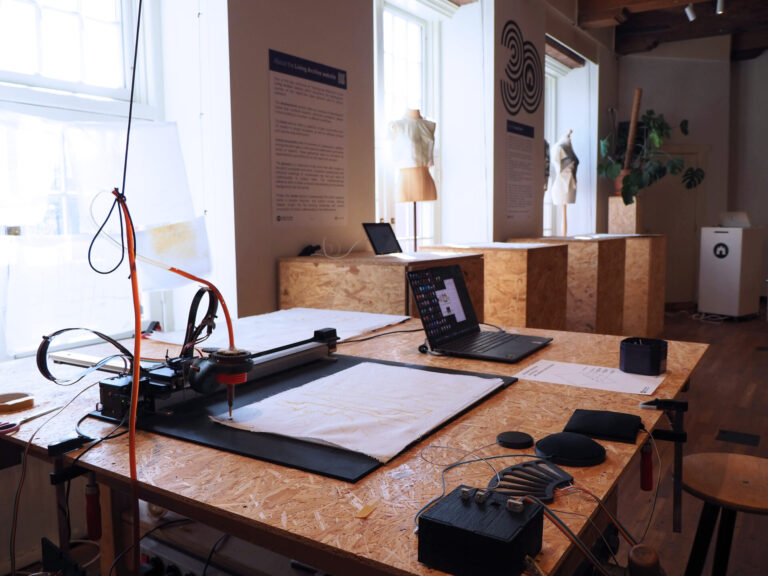
The Axidraw is a pen plotter developed by Evil Mad Scientist. It is a 2-axis CNC machine originally developed to be used with writing instruments. This is one of the CNC machines hacked in the pilot.

Staphorster Stipwerk drukker

B

Block printing

block printing is a technique to print on textiles or paper using carved wooden blocks. The wooden blocks can be reused many times after the initial laborious carving work.

C

CNC machine

A CNC machine is a machine that is digitally controlled with a computer. CNC stands for computer numerical control. CNC machines can range from milling machines and lathes to 3D printers and (pen) plotters. In Hacking the Machines, we are hacking CNC machines, specifically a Shopbot milling machine and an Axidraw pen plotter.

Code, Coding

Code is the language of a machine, the instructions for computers to perform tasks.

Coding (or computer programming) is writing, creating or generating instructions for computers to perform tasks. We are using Grasshopper to generate code for CNC machines.


Craftsmanship

The skill of making of a craftsperson.

Craftsmanship 2.0

The skilful mastery of performing a hybrid craft that acknowledges the power of both human and technological agencies. It recognizes the value of the performing act, the spontaneous intervention and various degrees of production freedom.

A craftsperson 2.0 is a craftsperson who isn’t afraid of mixing traditional crafting techniques with modern technology. The craftsperson 2.0 is well versed in the ways in which they are able to incorporate technology that best suit their crafts process.

Craftsperson

A craftsperson is a person who practices crafts. Originally the word craftsman would be used, however, this is a gendered word. Craftsperson doesn’t carry this genderedness and creates inclusivity when talking about people who practice different crafts.


D

Drukken (NL)

Drukken is the Dutch word for printing. The Dutch word ‘druk’ means the force that presses on or against something, which is something that is lost in the English translation.

Drukker (NL)

Drukker (roughly translated as printer, see Drukken) is the term used in Staphorst for craftspeople specialised in Staphorster dotwork.

E

F

Fabricademy

Fabricademy is a 6-month international educational programme that explores the intersection of textiles, digital fabrication and biology. Fabricademy runs in various nodes all over the world. TextileLab Amsterdam is one of the initiators of the programme, bringing innovation and access to technology for textile, fashion and material designers. Here, researchers, artists, engineers and creatives explore together the future of the textile and clothing industry. You can think of it as a playground for craftsmanship, heritage, technology, digital fabrication, shared knowledge and biology.

G

Grasshopper

Grasshopper is a visual programming language and environment in Rhinoceros. Programs are created by dragging components onto a canvas and creating connections and relations between them.

(Regular) Grid

Grid is a geometric framework composed of regularly spaced points or lines that divide a surface or space into repeatable units. Grids provide structure for organizing form, guiding movement, and distributing material or operations in both digital and physical environments. Grids can take on various configurations depending on the logic of repetition. In this project, we explore rectangular, square, triangular and hexagonal grids.

Examples of grids you can develop with the designer definition in Grasshopper

Example of Grasshopper code on the right side of the screen, with the resulting grid on the left side of the screen
Example of Grasshopper code on the right side of the screen, with the resulting pattern on the left side of the screen

H

Hacking

Hacking is the act of using a tool for purposes it was not necessarily intended for. Our pilot is called Hacking the Machines because we are developing hacks for CNC machines, using them outside of their usual context to print on textiles.

Haptic

Haptic is a form of information input for the craftperson which they use in the making of their craft. Within the craft process a craftperson uses different senses: haptic is the sense of touch and can also be an embodied practice.

Not to be confused with haptic feedback, which is used to describe touch feedback from digital systems back to the user, usually through tactile sensations like vibration. In our research our focus is on the haptic input of the user into the system, not the other way around.

Hands

The hands are essential in the making process. Imparting the printing or painting movement, holding the tool, is similar yet different in every person.

Hardware

Hardware encompasses the physical and electronic parts of a computer or other piece of equipment, rather than its software (via Cambridge Dictionary)


Hybrid encounter

The moments when we come together as the pilot team, or with external stakeholders such as the public or experts, to experiment with and reflect on the HaptiColor process. They are the key moments driving our machine hacks further.

I

Interactivity

Interactivity in Hacking the Machines means being able to intervene in machine printing processes through input devices.

Input device

An input device is something that measures sensor data: like pressure, temperature, angle, stretch etc. We use existing and custom input devices to interact with hacked machines: user input is translated to machine output like brush motion and ink flow.


J


K


Living Archive exhibition on April 10 and 11 2025

L

Living Archive

A hybrid environment that seeks to document our experiment through activating processes like how-to guides, stories, a glossary, and an overview of results. This website, together with the physical results, encompasses the Living Archive of Hacking the Machines.

The Living Archive seeks to connect historical traces and current narratives with the creative and performative processes of the experiment to speculate and imagine future directions for the craft.

M

Machine

A machine is equipment with moving parts that uses power to do a particular type of work. The types of machines we are using are CNC machines that move in X, Y and Z directions.

Machine-specific attachment

A machine-specific attachment is a part of the tool holder that connects a universal (i.e. can be used with any machine) tool holder to a specific machine. Our base machine is the Axidraw, so this machine does not need a machine-specific attachment.

Medium

A medium is the material that leaves a mark on cloth, either as colouring ink, as primer for colouring or as negative for resisting against colouring. Our focus is on natural pigments but we also work with existing (synthetic) dyes in our exploration.

Modular systems

Modular systems offer flexibility in our experimental processes and are used to mix and match tools, inks, interaction devices and other variable parameters in hacking the machines. See also Interactive devices development.

Mordant

Mordant is a substance that ties the dye to the fabric and ensures light-fastness and can enhance the dye molecules for more vibrant and long-lasting colors on fibers or textiles. There are many different types of mordants for different purposes and each have a different effect on the final color outcome.  Historically, it is believed that Egyptians and Mesopotamians were the first to use mordant dyes and the practice of mordanting can be traced back thousands of years. Many things can mordants, such as metals and salts. There are also organic mordants that split into two parts: plant-derived and animal-derived mordants. It is not always necessary to mordant but most animal and plant resources seem to need mordanting when dyeing.  The most commonly used mordants are alum, iron, copper and tin. Mordants can be used either as pre-mordanting before dyeing, or as a modifier after dyeing – these different methods make it possible to extract different colors. (via https://localcolor.amsterdam/glossary#mordant)

N

Natural dye

Natural dyes are dyes or colorants derived from natural sources like plants, insects, bacteria or minerals.

O

Open Source

When something is made open source, it means that the code, design files and/or instructions on how to make it are made freely available for possible modification and redistribution. We are developing our hacks according to this model, documenting and sharing all of our design files, code and considerations on this website, so our hack can be replicated in other laboratories across Europe that hold similar equipment and can be tested across our networked academies, such as FabAcademy and Fabricademy.

More information on the Open Source model can be found here.

P

Python

Python is a versatile, high-level programming language that (among many other things) can be used to control the Axidraw.

Parameter

A parameter is a variable or input that defines or influences the behavior, form, or outcome of a system. Changing a parameter changes the result.

Parametric Design

Parametric design is a process where relationships between elements are defined by parameters and rules. Instead of modeling a single outcome, designers create systems that can generate many variations by adjusting the parameters. It allows for flexibility, automation, and responsiveness in design.

Q


R

Rhinoceros

Rhinoceros (abbr. Rhino) is a commercial 3D computer graphics and computer-aided design (CAD) application. We are using Rhino in our pilot because the included program Grasshopper allows us to create code for all kinds of CNC machines visually.


S

Shopbot

Shopbot is a 3-axis CNC milling machine, originally developed for use in subtractive manufacturing of rigid materials such as wood boards.

Software

In contrast to hardware, software encompasses all of the (intangible) computer programs that instruct the electronic parts of a system: the instructions that are executed by the hardware.

Staphorster Stipwerk

Staphorster Stipwerk (dotwork from Staphorst) is a craft that came about in the beginning of the past century in Staphorst. This craft, which is shaped by the use of stamps made from cork and nails or pins, is still practiced today. You can read more about it here.

Sensor

Sensors are devices that detect and measure physical inputs, such as pressure, force, touch, motion, or stretch, and convert them into signals that a system can interpret. In haptics, sensors play a crucial role in capturing how a user interacts with a surface or object, enabling real-time feedback, or control.

T

Template

Template is a predefined pattern, structure, or framework used as a starting point for creating consistent and repeatable versions of something. It serves as a guide that preserves essential features while allowing for variation or customization. Templates can take many forms—physical objects, digital files, or parametric models—and are used across disciplines to streamline processes, ensure accuracy, and save time. In design and fabrication, templates help replicate shapes, align elements, or define motion logic, whether manually or digitally. In craft practices, templates are often handmade patterns or reusable guides that assist in shaping, cutting, or assembling materials. Templates in crafts support reproducibility, precision, and tradition, while still allowing the maker room for improvisation and personal expression. They are tools of both efficiency and embodied knowledge, often passed down or developed over time.

In Staphorster Stipwerk, with the help of a template, the craftsperson creates a diamond-shaped outline by placing single dots on the fabric after which the pattern is filled colour-by-colour and shape-by-shape creating a symmetrical pattern throughout. (via Staphorster Stipwerk as Intangible Cultural Heritage)

Tool

A Tool in crafts is any object or device used to shape, manipulate, join, or transform materials. Tools extend the capabilities of the maker, enabling precision, efficiency, or specific techniques. Often, tools in crafts are deeply tied to technique, and sometimes even to identity: the tool becomes an extension of the craftsperson’s hand, embodying skill, memory, and tradition. In crafts, a tool is not just a means to an end, but part of a dialogue between hand, material, and technique.

A brush, extruder, stamp or matrix transferring the ink medium onto the cloth, through movement.

Tool holder

Tool holders form the bridge between tool and machine.


Example of tools used in Staphorster Stipwerk

U


V


W


X


Y


Z