
The optimisation of textile printing to date has been in the direction of mass production, often losing some of the freedom and expression of the craft with each step. Is there a new way forward with open access to technology, where the craftsperson can be continuously involved in a digital process?
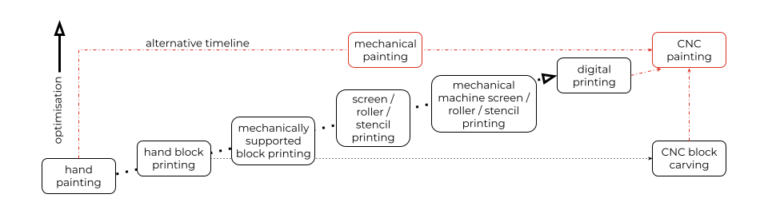
We have created a visualisation of the evolution of textile printing from hand painting to modern digital printing, with the steps in between representing further optimisation towards upscaling quantities. The last step of this optimisation is digital printing, which has been in development since the late 80s. Our research within Tracks4Crafts builds on previous printing methods and explores alternative timelines (shown in red) – what would have happened if the optimisation of hand painting hadn’t been a block, but the mechanisation of the brush stroke? What would mechanical painting have looked like after the Industrial Revolution? What it could be now – CNC painting and printing – and how this relates back to the craftsperson in the process is what we’re exploring in our pilot.
Hands, arms and body
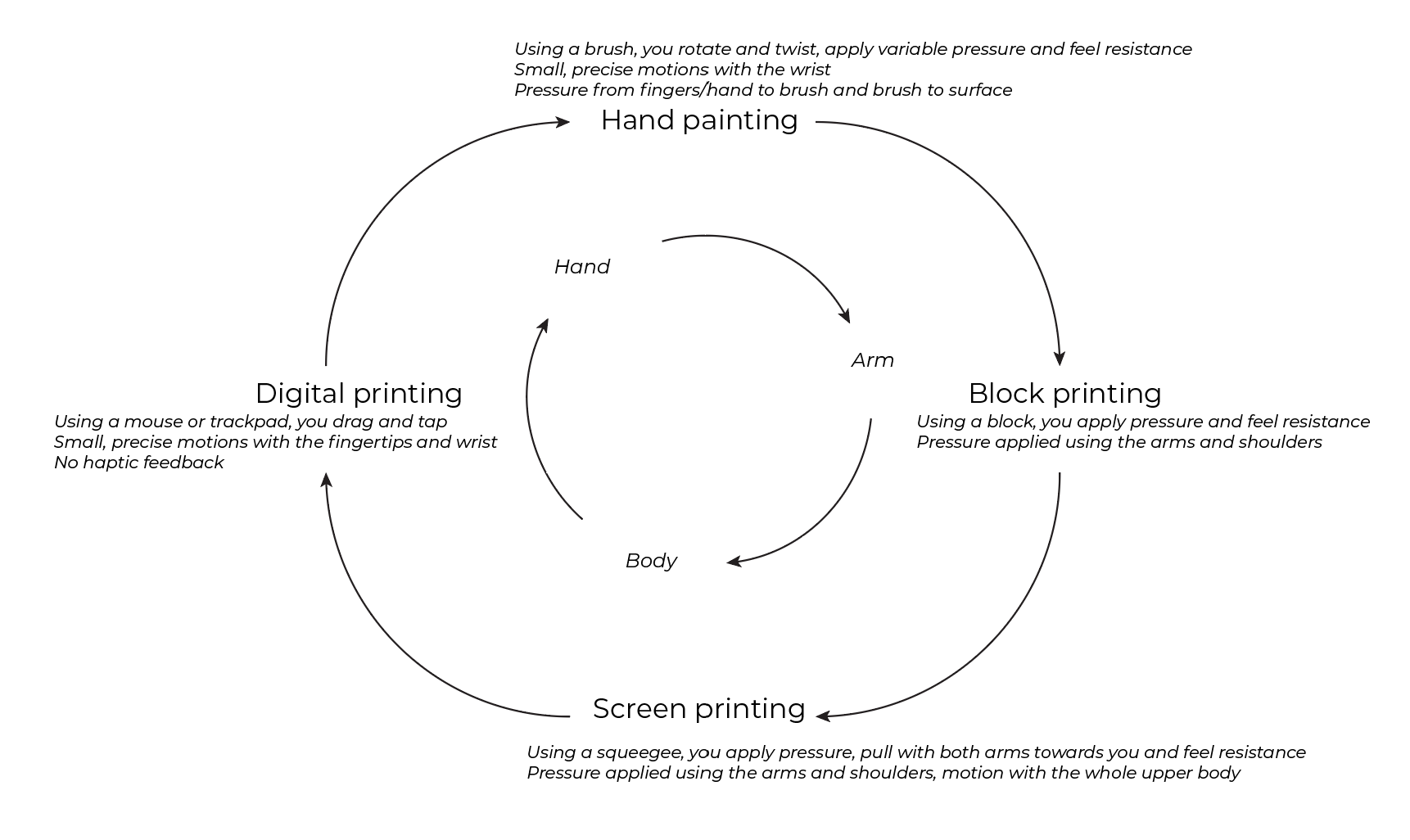
When focusing on four of these distinct techniques – hand painting, block printing, screen printing and digital printing – and how they relate to the body, we see an evolution from:
- using the hand and wrist in hand painting, using small and precise motions
- using hand, arm and shoulder in block printing
- using the whole upper body in screen printing
- returning to using the hand (mainly the finger tips) and wrist in digital printing, using small and precise motions with the focus on designing and operating the machine on a computer
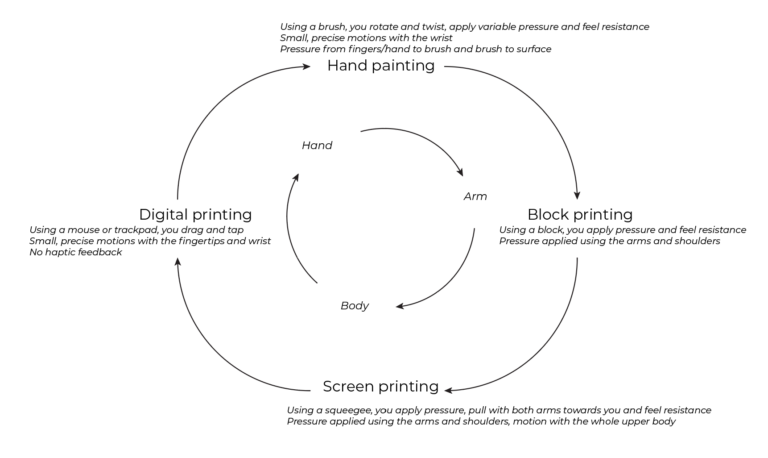
In the graph below this cycle is visualised. We are explicitely drawing another arrow from digital printing back to hand painting, as our pilot is combining digital printing methods with hand painting (and block printing) methods. Also etymologically the connection between the hand and the digital is there: the word digital is derived from the latin word digitus meaning finger or toe.
In our pilot project, we aim to continuously involve the fingers, hands, arms and body of the person printing on textiles in the machine printing process. To achieve this, we are researching and developing interactive input devices to detect the user’s touch, pressure and gestures. This input is then translated live into brush strokes and pressure applied to the fabric. Read more about the development of our interactive devices here.
References
https://www.etymonline.com/word/digital