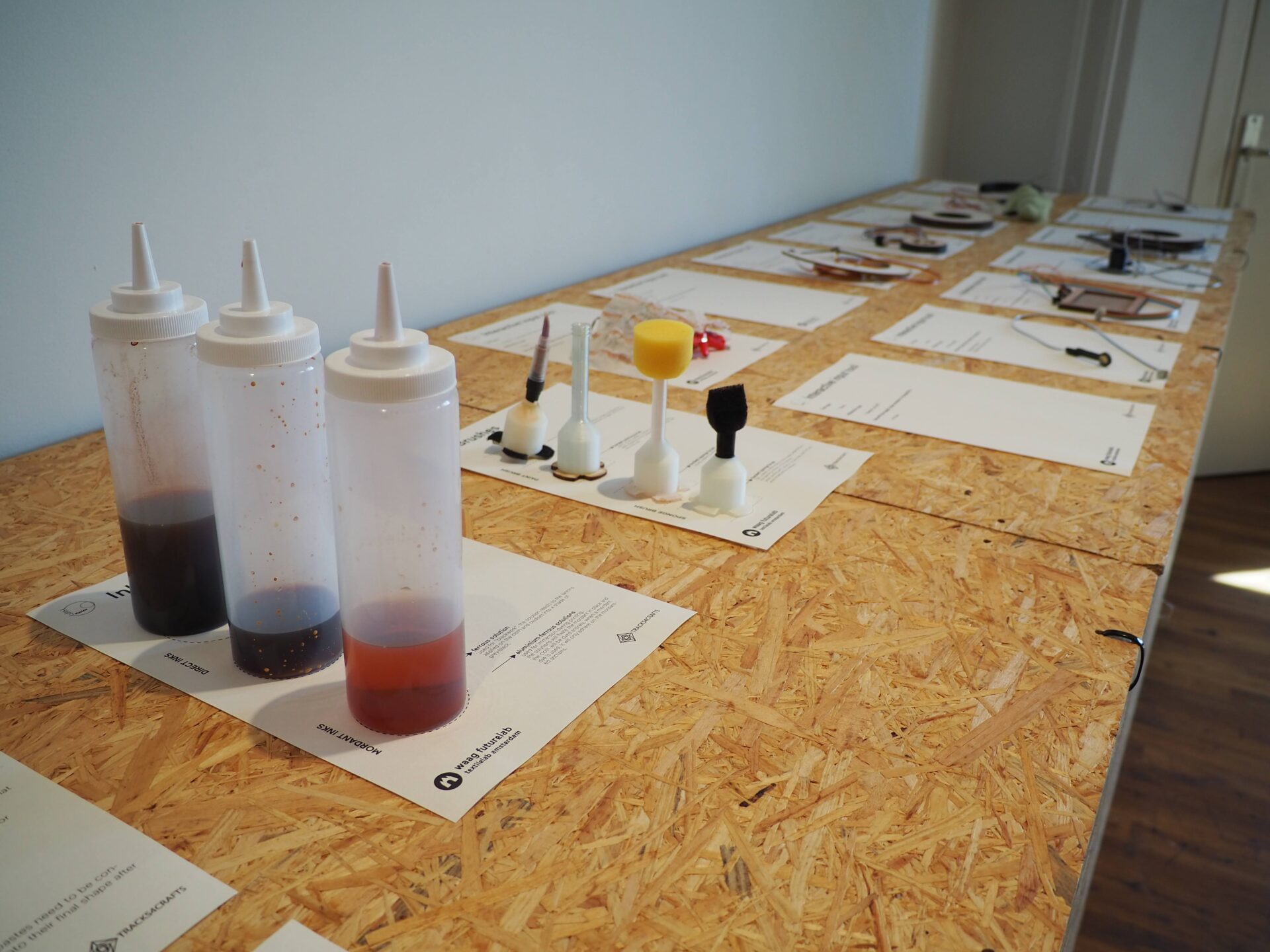
Is a technique in which one or more varieties of thickened mordant pastes are applied to cloth, fixated via immersion to remove the thickeners and then dyed in an immersion dye bath.
The result here of is a most often a white background (or the initial, or natural color of the cloth) with clear coloured sections where the textile was printed, even though the entire textile has been submerged into the dye bath, the dye will only bind itself with the mordanted sections. This specifically works at its best when the dye used for the immersion dyeing step does not bind to un-mordanted fibers. This depends on what typology of biochromes (dyeing molecule) is at work in the dye bath. Dyes that do not require a mordant, or that produce different stable colours on both mordanted and un-mordanted cloth, will instead result into tonal variations across the cloth.
The mordant selection in combination with the dye chosen, will determine the outcome of the colour scheme – often brighter or more intense where aluminium mordants were applied, or darker and shady where ferrous mordants were applied – meaning that each colour result is determined by the individual combinations of biochrome and mordant or biochrome and cloth. Mordant pastes can be overlapped, to create in-between shades and gradients across two mordants.
The steps of the process:
- Scouring of cloth
- Preparation of mordant paste
- Printing, deposition of mordant paste in place
- Fixating (drying, immersion dunging)
- Immersion bath dyeing
- Rinsing
- Clearing of background
The preferred mordant for the paste in this case is a thickened acetate-type, to be utilised fresh or within 12 hours from mixing. The metallic salts tend to “eat” into the thickening agents, such as gums, breaking them down and making them unusable. Drying of the print is extremely important in this case, to retain precise areas and avoid mordant bleeds, no smell should be left onto the cloth before proceeding into the next steps. Dunging is carried out to both neutralise the acetate solutions and remove the remaining gums from the textiles. The immersion bath dyeing is carried out as any other traditional dyeing process, following the requirements of the dye matter used – caring for both correct temperature and ph parameters in order to achieve the best prints.
Especially when mordant printing ph-sensitive dyes produce different outcomes, testing these variables through a number of different ph-modifying additives is required for each dye matter type.
Mordant printing has the ability to be also used for “black-work” printing. When the ferrous mordants are used in combination with tannins a variety of shades of grey and blacks can be achieved. In this case the mordant printing happens on tanned cloth or is followed by an immersion bath into tannins.