
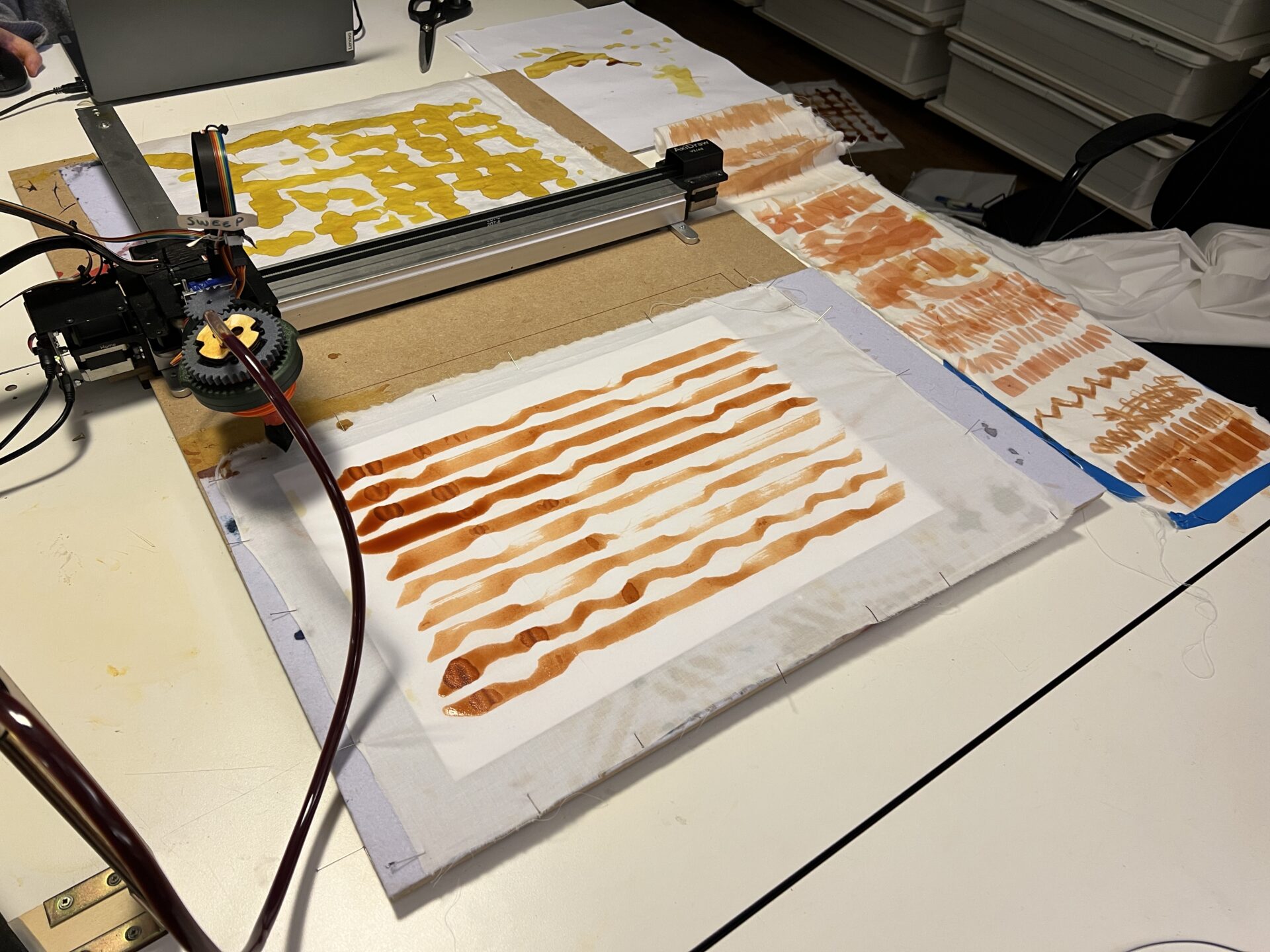
When exploring biochromes as a more sustainable alternative to synthetic inks or acrylic paints, a number of routes appear, each holding its pros and cons, each offering a different set of materials, tools, steps and results with their own accompanying aesthetics.
Biochromes
Biochromes are available in nature from a vats number of sources, they can be explored as 6 main domains:
- animal – insects or resins produced by insects
- bacterial – chromo-bacteria
- botanical – seed, leaves, flowers, plants, roots, barks, woods, fruits and shells
- composite – lichens & galls
- fungal – mushroom fruiting bodies & spores
- mineral – soils, ochers, oxides
Each of these categories provides natural colours sources, biochromes.
These colouring molecules can either be extracted in a solvent, which can be water-based or ethanol-based, and transferred into the textile or bound to cloth with proteins, onto the textile.
For extensive research on all the varieties and outcomes of biochromes, we suggest you look into our resources:
- Local color, by TextileLab Amsterdam Waag FutureLab
- Biochromes Color Archive by Cecilia Raspanti
- Fabricademy: Biochromes by Cecilia Raspanti
or resources of other practitioners such as Dominique Cardon, Michel Garcia, Catherine Ellis, Maiwa, Julie Beeler, etc
Colour & cloth
Firstly, its important to understand more about the fastening of biochromes into textiles, this mainly happens through mordants for the largest number of botanical dyes, these are in fact called mordant-dyes. Nonetheless, a small number of other botanical dyes (and other dyes sources) do not require a mordant, while other dye materials, such as tannins, mainly react with ferrous mordants.
To read more about what mordants are, their qualities, appearance and uses, read more information in our other project: localcolor.amsterdam, which focuses specifically on local sources of materials, as well mapping the required processes for everything that has to do with natural dyeing and much more.
The tool perspective
From a different angle these techniques, processes and materials could simply be organised as
- painting – free hand, depositing colour, mordant, binder or wax in form or solution or paste onto cloth, via hand-tools
- block printing – utilising hand carved wooden blocks for depositing colour, or mordant or resist paste, pressed onto cloth
- screen printing – utilising a frame with a tight screen/netting surface treated to create a design of closed of sections and open areas where paint, mordant or resist can pass through the netting are transferred onto the cloth
- binding & clamping – creating a physical interference in form of pattern or design, where the dye cannot reach the cloth and thus cannot dye
ChromaPrint focuses on digitising the painting aspect, developing a print-painting technique.
Processes
When we explore how colour can be deposited onto cloth, a number of different routes opens up:
Printing-painting
-
- Direct printing – to achieve a vast colour variety on clear backgrounds
- Printing of mordants – to achieve tonal colour results on clear or dyed backgrounds
- Printing of mordant on tannins – to achieve ‘blackwork’, greyscale or black&white
- Discharge prints for additive mordant printing – to interact with or correct mordant prints
Resist-printing
-
- Batik – wax resists for submersion dyeing and painting
- Shibori rōkechi – wax resists patterns
- Clay resists for indigo – for blue-work
- Soy resist for indigo – for blue-work
Resist-physical barriers
-
- Shibori kōkechi tied or bound resists
- Bandani knot work, similar to kōkechi
- Shibori kyōkechi, resists where the fabric is folded and clamped between two carved wooden blocks
For our ChromaPrint machine we test 3 of these routes – departing from printing painting techniques, which are explained step by step in the ‘Principles of bio-based printing on textiles’