
To get a sense of what is out there already regarding custom and hacked machines for drawing we looked at various makers working with plotters. Our main goals are to discover what’s out there already and who is doing inspiring things with machines and crafts. We break down the research into five focus areas: the hands, the medium, the tool, the machine and the code.
Hands
Imparting the printing or painting movement, holding the tool, similar yet different in every person. More broadly speaking we’re looking at embodied movement.
Haptics
Craft practitioners
Kaargari is an an art project by Rashmi Bidasaria aimed towards highlighting artisans individuality in their craft practive in the way their hands and body move while performing their craft.
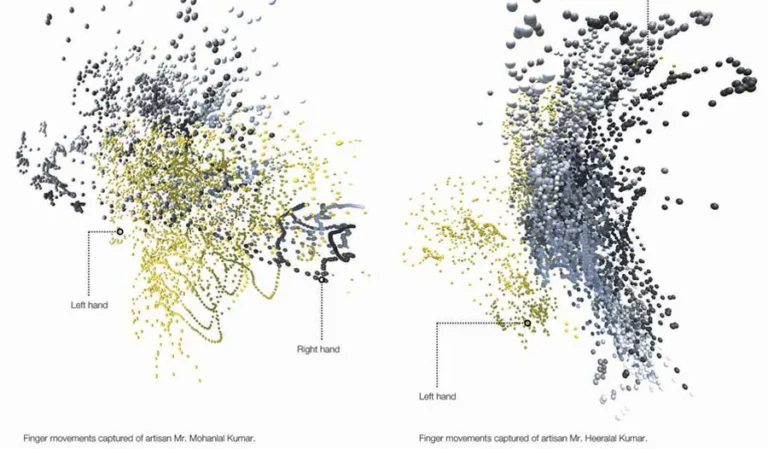
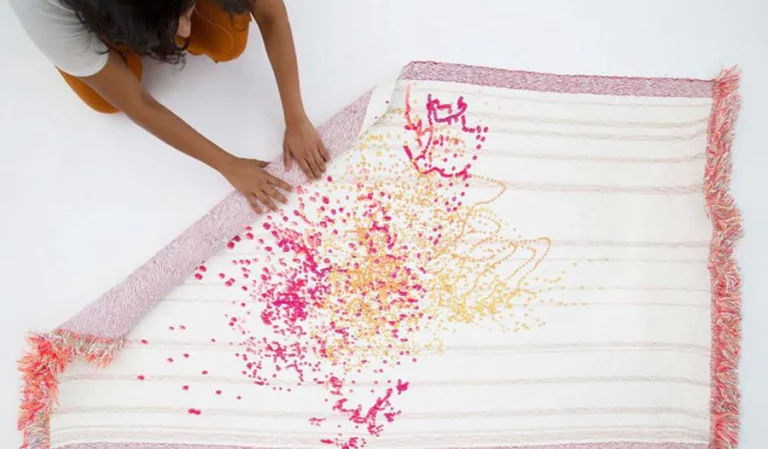
Gesture comparison — These patterns depict the gesture mapping of 2 artisan-brothers. The dots clearly showcase how differently they practice their craft. Yellow – Left Hand, Blue – Right Hand. Recording a visual map of the finger gestures of the artisans gave an insight into their movement and work spaces that led to a deeper understanding of their finger gestures. (Quoted from the project page)
Medium
Leaving a mark on cloth, either as colouring ink, as primer for colouring or as negative for resisting against colouring. Our focus is on natural pigments (more on that on the recipes overview) but we will also work with existing (synthetic) dyes in our exploration.
Storing mediums
How to get the medium on the fabric? Some options include:
- Integrated medium reservoir (in brush or in tool)
- External medium reservoir (going back and forth to it in code)
- Placing medium directly on the surface
Modifiers
By using alternative mediums you can create interesting textures. Engraving into wet paint with a different tool in the tool holder can result in embossed surfaces.
Tool
A brush, extruder, stamp or matrix transferring the medium onto the cloth, by means of movement. Tool holders form the bridge between tool and machine.
Brush motion
In the following videos, these various principles are visualised by examples from various plotter artists and experts. At the bottom of the page you will find links to their work. Combining techniques to create composite motions.
1. Dragging
- Dragging with a brush (flat)
- Dragging with a brush (on an angle)
- Dragging and pausing
2. Rolling
- Rolling a roller (one direction)
- Rolling a roller (drag direction)
3. Rotating
- Back and forth
- Continuous
- On and off center
4. Swinging
- Omnidirectional
- Back and forth
5. Up and down
- In code
- Using servo-motors, solenoids, cam-follower
Links to artists:
- https://arnaudpfeffer.com/
- https://florianmarkus.com/
- https://chrisbly.com/
- https://penplotterartwork.com/
- https://www.instagram.com/alwaysplottingsomething/reels/
- https://fab.cba.mit.edu/classes/863.21/CBA/people/catfang/hw/final.html
Machine
What embodies a mechanised or numerically controlled version of the hands, acting as “what imparts the printing action”, but that also becomes an extension of the hands.
The machines that we will be working with are the Axidraw V3/A3 and the Shopbot. We had a look at what else is out there (now and historically) regarding custom made (open source or not) CNC machines, and hacks made for existing machines.
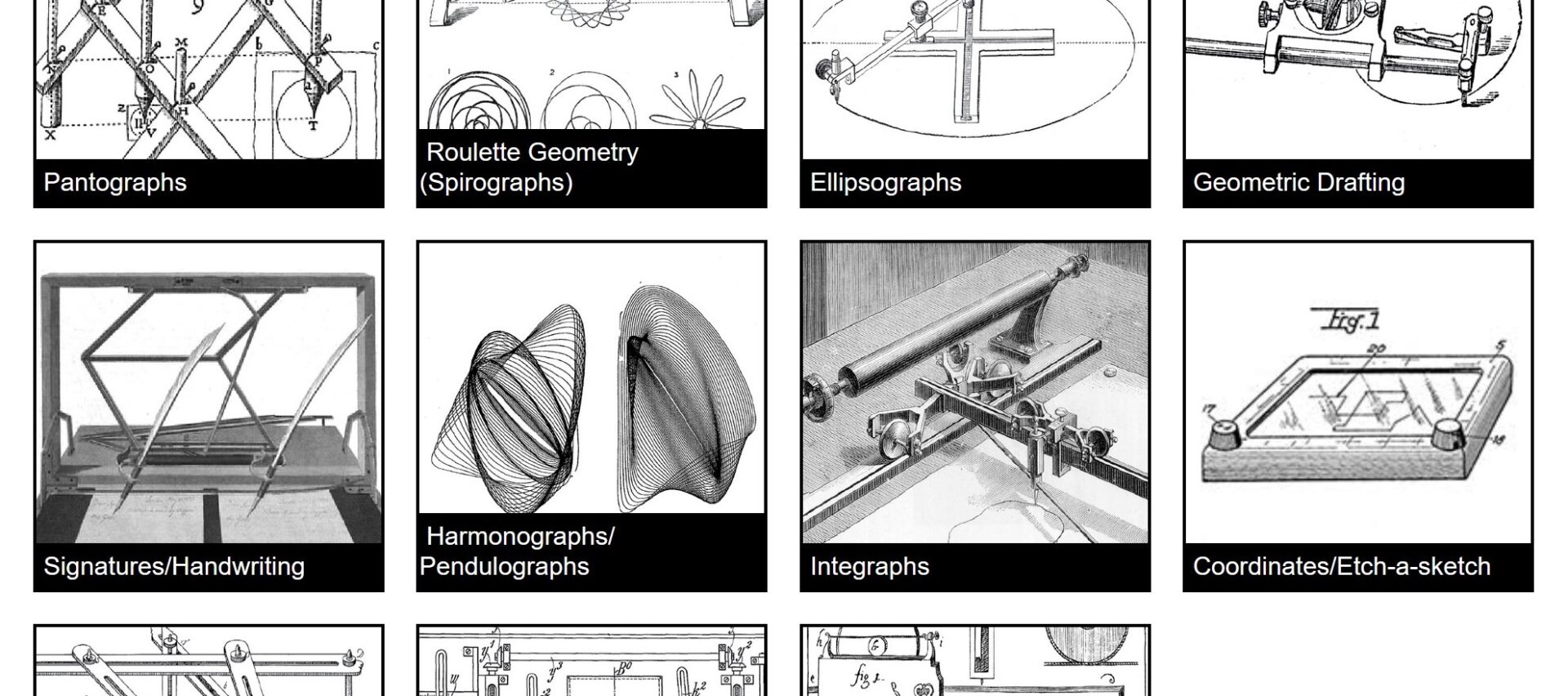
To start with, DrawingMachines.org is an archive of optical, mechanical and automated drawing machines, devices and aids.

Hacked machines
-
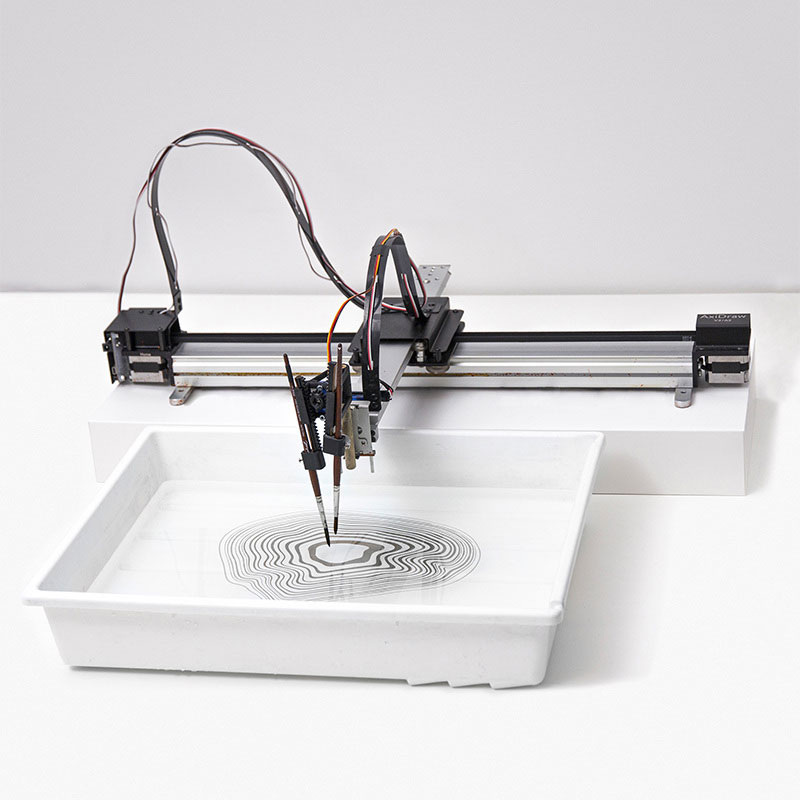
Automated Suminagashi Machine by Arnaud Pfeff(er. This is an Axidraw with a custom tool holder which consists of a servo motor and two 3D printed linear actuators that lift two brushes alternatively.
Custom made machines
-
Cycloid Drawing Machine (analog spirograph) by Joe Freedman

-
Spirograph by James Nolan Gandy

-
Mini CNC Plotter (via Instructables). This a micro servo motor to control up and down motion similar to the way Axidraw does.

-
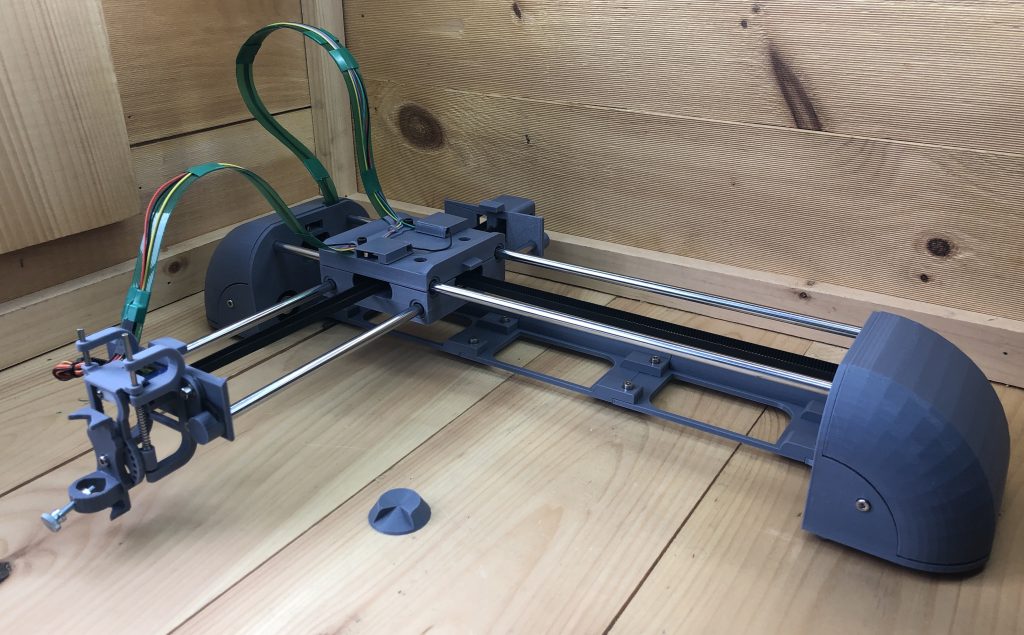
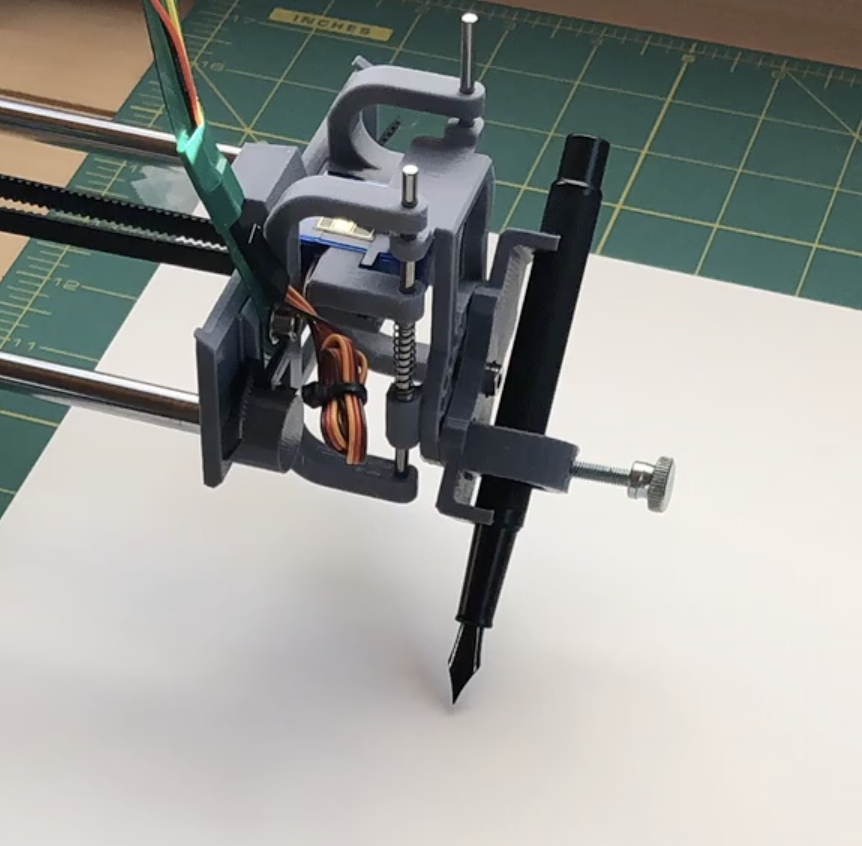
Plottybot by Ben Akrin has a great pen rotating mechanism as can be seen in this photo.
Machine attachments
Since we want to make a tool holder that can be attached to multiple machines, we need to have a connection system between a machine-specific attachment and a universal tool holder. What are feasible ways to implement this?
Keeping in mind that we will 3D print the attachments, some options are:
- Magnets
- Slide-in: Michelle made this slide-in syringe holder for a 3D printer (Ender 3) that was turned into a paste printer. It’s a simple system, but not very stable (it needs a piece of paper to make sure that it doesn’t shake) > maybe can work with added screws
- Wood-joints
- Screw-in: may be pretty stable but annoying if you cannot rotate a part
- Buckle style