
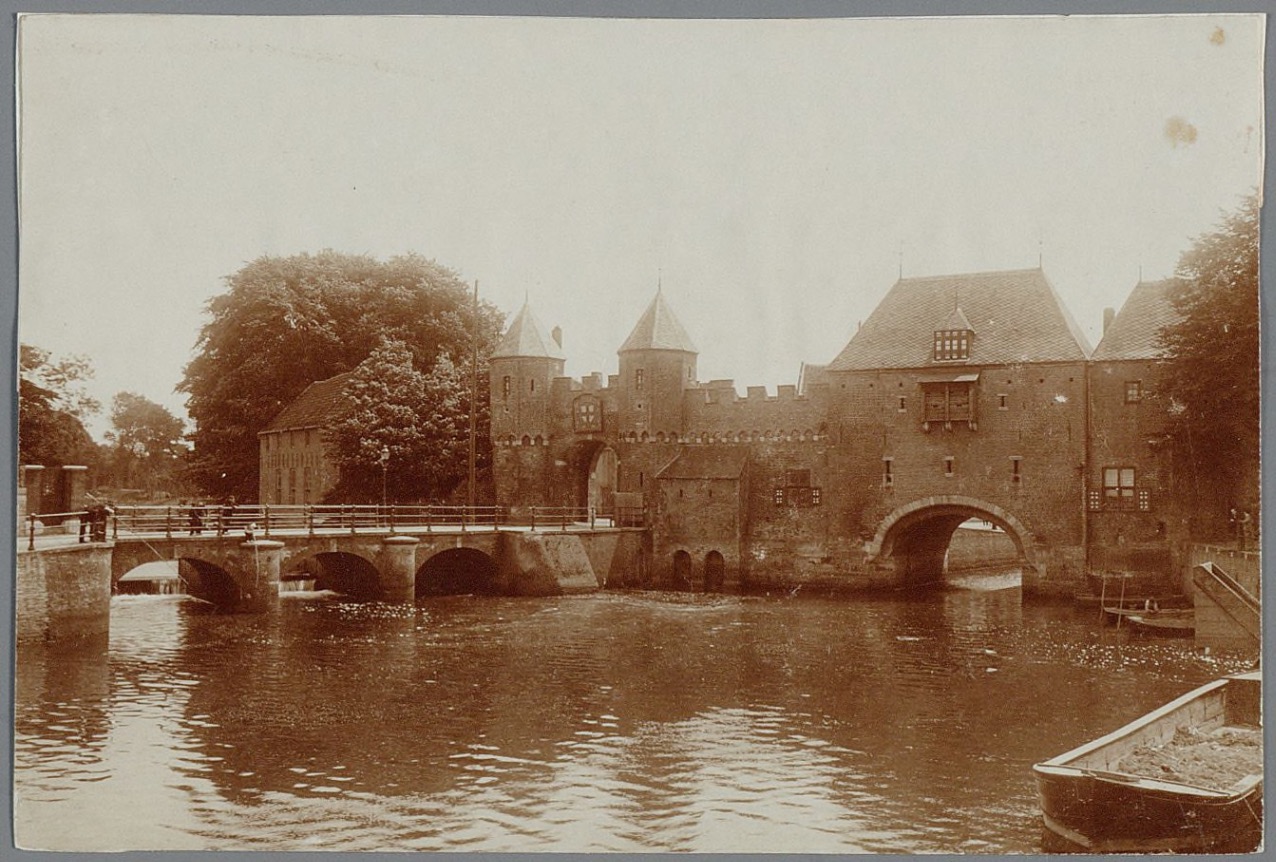
Walking into de Volmolen is like walking into history. The building is situated in the old city walls of Amersfoort (Netherlands), as can be seen through the rounded arches at the entrance. Inside, the floor is characterized by bricks laid in square patterns, and dark wooden beams support the ceiling. De Katoendrukkerij, a block-printing workshop, is situated inside the building; tables and chairs are organised at the back of the space, and on top of the tables black printing mats are placed that are used as a surface in the printing process. A small cart with different coloured paints stands in the middle of these tables, and in the left-side corner, a collection of wooden printing blocks is set out. The space of de Volmolen has seen a long history in its life that reflects the textile history of Amersfoort.
On the outside wall of the back of the building a trace of a water wheel can be seen. The wheel was used to power a fulling mill that had been situated inside the building in the 17th century.1 Fulling is the process of felting woven fabrics using water, urine, and clay, turning them into watertight fabrics called ‘laken’ that could be used for clothes or curtains because of their insulating properties. This process used to be a handwork process, until the watermill provided the possibility for a industrialization of this process. In 1645 the city decided to build a fulling mill, called the Volmolen for 1500 guilders.2 The Volmolen was placed on the outskirts of the city, inside the city wall of Amersfoort next to the koppelpoort, the gate into the city. 3 In 1669 two big problems arose within the fulling mill; a sewage leak occured underneath the watermill and a few months later a leak in the fulling mill caused water to spill inside the mill that endangered the water level within the city as well as the foundations of the fulling mill and the koppelpoort.4 A year later the decision was made to sell the mill for 1570 guilders.5
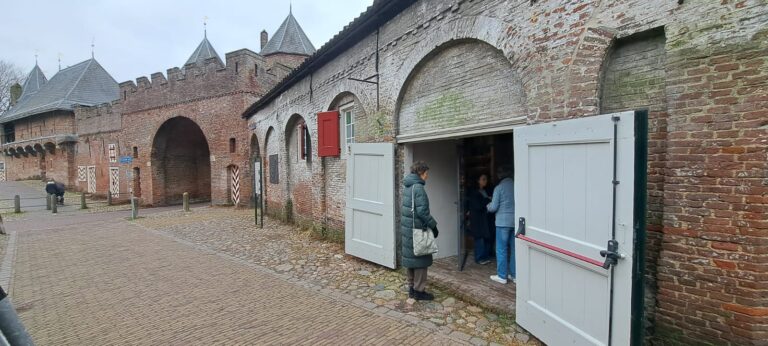
On the side of the Volmolen there is a typical Dutch door, a door which is divided in half, and can opened on the top and bottom. Ineke Hylkema, who lived in the Volmolen in the 1950s, was often found talking to the neighbours with her dog at her side while she was living there.6 After the Second World War, the mayor of Amersfoort decided to introduce more artists to the city and place them within the monuments. This was how Ineke and her husband Bertus Hylkema, a wood and ivory carver, came to settle in the Volmolen around 1950 after the building had been used as a coal storage, carpentry workshop, and housing for six families in the previous decades. To prepare the building it was renovated in 1950, creating a living space within the building in addition to a workspace for Bertus and Ineke to stay and live in. Bertus’ studio was located in the attic of the building, where racks of different kinds of wood would stand.7 A wall divided the space from the heavy machinery used to turn and carve the wood. The space on the ground floor was too cold to live in and was rented out to a hand-weaving mill.8 In this space, four to five big looms were set up together with a big wheel to spin the wool on.9 The sounds heard at the time were those of the loom; pedals pressed in and spools swishing from side to side. This again reflected the history of the textile industry that arose in Amersfoort.
The earliest mentions of textile production in the archive of Amersfoort date to the 15th century.10 By the mid 16th century Amersfoort’s ‘Laken’11 had been sold to a monastery, showing the ability of Amersfoort to compete with other cities in the Netherlands known for their production of ‘Laken’.12 There were strikes by weavers and fullers in 1555, and in 1640 a ‘Laken’ factory was started in the Agathaklooster.13 Not long after, the Volmolen was built in 1646 and in 1678 the first blockprinting workshop was established in Amersfoort.14 Two members of the Dutch East India Company (VOC), Jacob ter Gou and Hendrick Popta settled this workshop in Amersfoort after Chintz became a popular fabric for import.15 The technique of the making of this fabric came out of India. At first, the VOC traded these fabrics with Indonesia for spices; however, after the introduction of these fabrics into Dutch society they became commodities themselves. With the journey to and from India for these fabrics taking about two years, it became profitable to find ways of importing this process to the Netherlands. The printing workshop ‘de Katoen Drukkerij’ that is currently situated within the Volmolen highlights this history within Amersfoort. In 1850, around 500 weavers and 200 spinners were active in the city.16 These were people working from home as well as inside small textile factories.17 After the 1850s the textile industry in Amersfoort dwindled; wages were lower in other parts of the Netherlands which caused a lot of unemployment within the textile industry.18 Throughout its history, the space of the Volmolen reflects the innovations that were introduced in the Dutch textile industry. From the start of the mechanization of fulling to the settlement of a block-printing workshop, something that wouldn’t have been possible without the introduction of a new technique from India in the 17th century.
Why is this relevant
In January of 2024 the pilot team of ‘Hacking the Machine’ by Tracks4Crafts visited de Volmolen in Amersfoort to learn more about the blockprinting process. This created an insight into the background of mechanization processes within the Netherlands and the important factors to include within the Hacking the Machine pilot.
Collected by
Interview (verbal), research.
Sources
-
De Katoendrukkerij Documentaire “De Volmolen Amersfoort: De verhalen,” accessed March 21,2024, https://www.youtube.com/watch?v=4lEYqzTufvk&t=1s ↩
-
Rootselaar, Willem Franciscus Nicolaas van. De Koppelpoorten, De Volmolen, Het Spui, En De Kade Te Amersfoort: Historische Bizonderheden. Amersfoort: Slothouwer, 1885. https://play.google.com/books/reader?id=_7wrRgHyizQC&pg=GBS.PA2&hl=nl, 18. ↩
-
Documentaire “De Volmolen Amersfoort: De verhalen.” ↩
-
Rootselaar, 19. ↩
-
Rootselaar, 21. ↩
-
Documentaire “De Volmolen Amersfoort: De verhalen.” ↩
-
Documentaire “De Volmolen Amersfoort: De verhalen.” ↩
-
Documentaire “De Volmolen Amersfoort: De verhalen.” ↩
-
Documentaire “De Volmolen Amersfoort: De verhalen.” ↩
-
Geertruida de Moor and Ronald van der Spiegel, “Aankepen van Amersfoorts laken door het cisterciënzerinnenklooster Leeuwenhorst rond 1500.,” accessed March 21, 2024, https://historisch-amersfoort.nl/wp-content/uploads/2023/02/Flehite-Jaarboek-2012-114-121-De-Moor-ea-laken.pdf. ↩
-
‘Laken’; woven woolen fabric that has been felted. ↩
-
Moor and van der Spiegel. ↩
-
Oudheidkundige Vereniging Flehite Amersfoort, “Textiel,” accessed March 21, 2024, https://tijdbalk-amersfoort.nl/index.php/Textiel. ↩
-
HALI, “How the Dutch Made Chintz Their Own,” HALI, November 23, 2020, https://hali.com/news/how-the-dutch-made-chintz-their-own/. ↩
-
HALI. ↩
-
Canon van Nederland, “1850-1950 Eemhaven Industrialisatie,” accessed March 21, 2024, https://www.canonvannederland.nl/nl/utrecht/eemland/eemhaven#:~:text=Amersfoort%20stond%20bekend%20om%20zijn,er%20waren%20ook%20enkele%20textielfabriekjes. ↩
-
Canon van Nederland. ↩
-
Canon van Nederland. ↩