
VOC trade and the introduction of Chintz
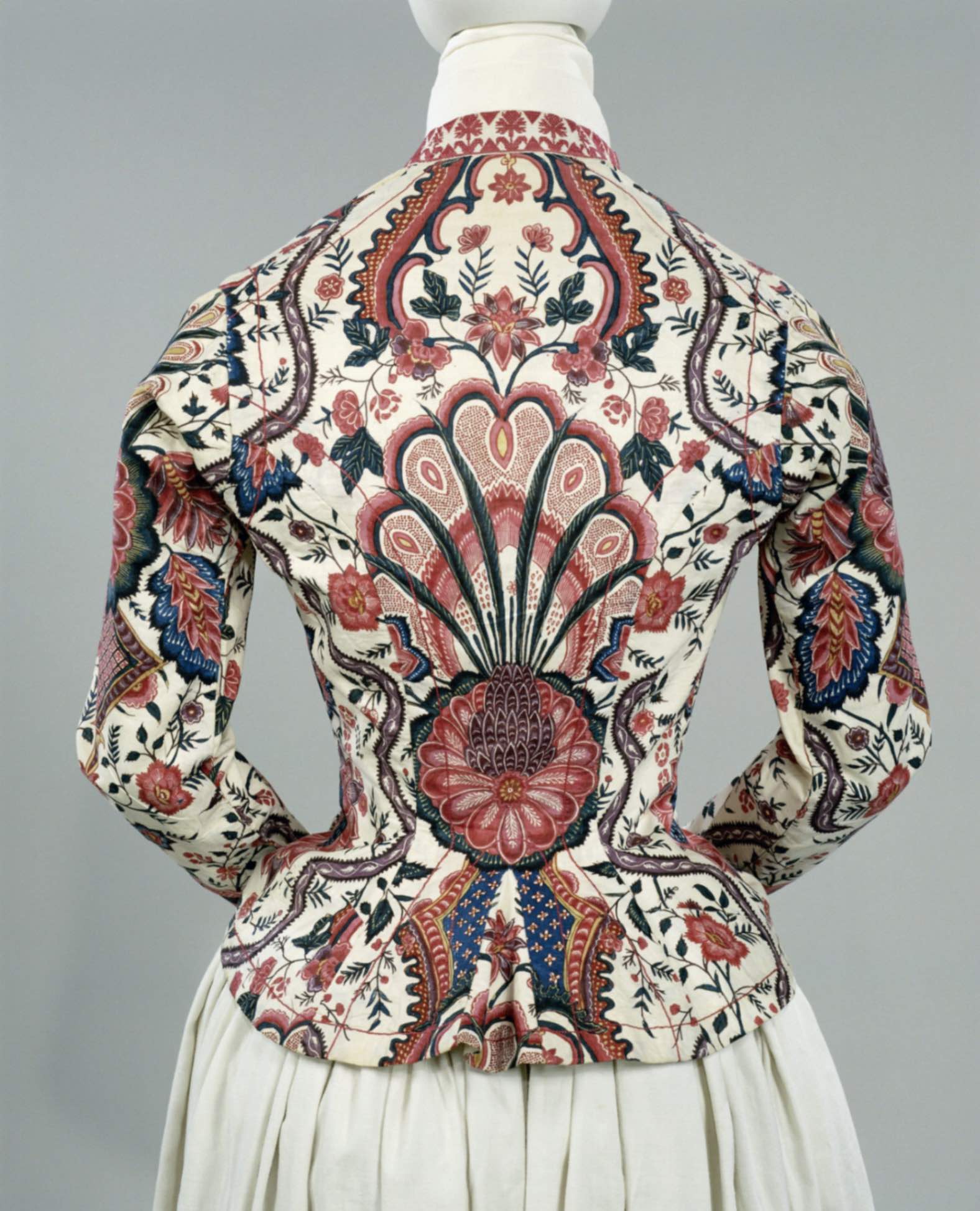
At the beginning of the 17th century, the Dutch East India Trade Company (VOC) was looking to make a profit and competed for the growing and lucrative spice trade. In 1604 the VOC took over the Moluccan islands from the Portugese1. The spice trade created the perfect circumstance for the start of the Dutch “Golden Ages”2. These spices were attained by trading with, among other things, a colourfully patterned cotton fabric called chintz which was produced in India. While the fabric was initially used as trade-ware, soon the attention on this fabric with its colourful lasting patterns caught the attention of Dutch high society. The fabric started to be used as decoration for the walls, and later was introduced into fashion adapting the fabric into garments3. The popularity of the fabric caused the VOC to issue an ‘Eisen van retour’4 in 1664, ordering the import of chintz for the Dutch market5. This was the start of a craze with this fabric which lasted for two centuries and we still see its effects today.
The innovation of Chintz
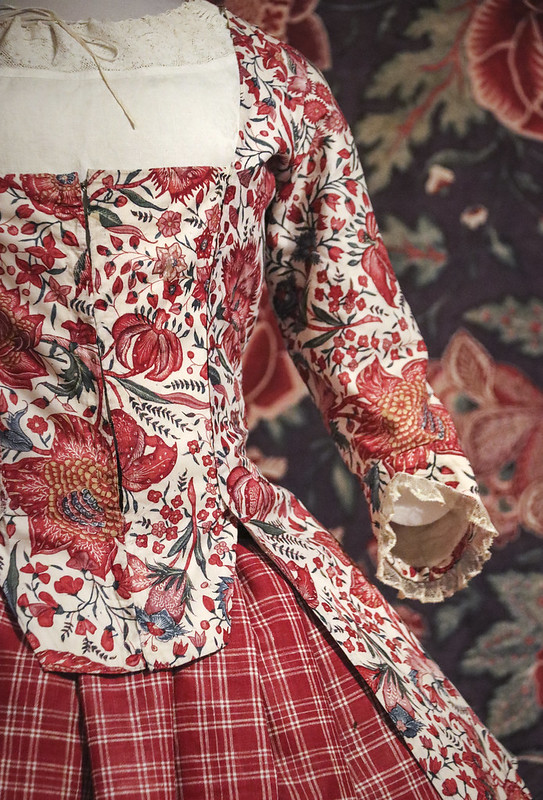
Chintz is characterized by its colourful patterns and lightweight cotton fabric, something that hadn’t existed before in Europe. The flat surface of the fabric made it difficult to get dirty, and the patterns created by a special dye technique from India were able to resist washing6. While patterned fabric existed before the introduction of chintz in Europe, the patterns were usually painted on with paints made of oil or egg whites which created unpleasant smells and caused the patterns to fade quickly – the paint wasn’t fixed to the fibres but only pasted on top of them7.
While most Indian chintz was hand-painted, a technique of printing with wooden blocks was used to create outlines (contours) of designs8. To prepare the cotton fabric for dyeing the fabric was treated with a mixture of myrobalan, buffalo milk and ricewater9. The motif was transferred by a pattern or stencil with holes that would be dusted with charcoal, leaving a pattern on the fabric10. To ensure the fixation of natural dyes in the fibres, metallic salts were used11. For black contours an iron salt was applied which created the black colour when it bonded itself with the myrobalan in the cotton fabric12. The colour red would be achieved by adding alum to the fabric; a dye bath would then intensify these colours 13. Through combinations of natural pigments and different metallic salts, an array of colours could be achieved after a red dye bath14. To achieve blue colours a dye bath was prepared with indigo, which had to be transformed to a soluble connection named leuco-indigo to be used15. Leuco-Indigo was only maintained through the absence of oxygen; the removal of oxygen was achieved by bacterial fermentation16. After applying wax to the areas of the fabric that needed to be green or yellow, the fabric was folded into a tight packet – diminishing its contact with oxygen – and was put into an indigo dye bath17. Yellow colours would be mostly applied by hand with a pigment made from turmeric18.
Influence of Chintz on fashion
In 1660 the request for chintz was so high that the European wool and silk industries opposed the import of the fabric19. In France and England, these protests caused a temporary ban on the import of chintz20. This created a smuggling system of Chintz through the Netherlands where import of chintz was still possible21. In the Netherlands, the business surrounding textiles grew, and in 1683 the first chintz merchants settled on the Warmoesstraat in Amsterdam22. Later, in 1742, there were 30 chintz shops as well as a total of 324 shops related to the selling of fabrics23. While at first chintz was seen as an exotic and luxury article only available for the upper classes, the colourfully printed cotton fabric became available for cheap prices after European block printing workshops opened24. This ensured the ability of lower classes to utilize the fabric. Around 1785 Chintz grew out of fashion for the upper classes; however, lower classes kept wearing the fabric longer25.
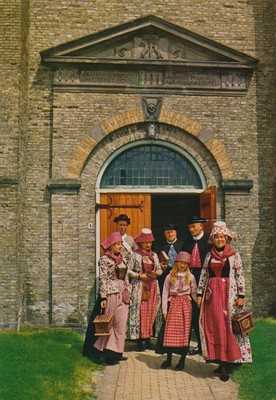
Chintz was considered to be a very valuable fabric, even after it grew out of fashion as it is often reused26. The fabric is used for childrens’ clothes, blankets, curtains, and simple jackets27. Women from the countryside and in smaller cities often wore the colourful fabric, which is especially seen in Friesland where the fabric left its traces in the traditional clothes of the region28. The Hindelooper traditional clothing which disappeared late 19th century is a perfect example of this29. The traces of chintz were also left in other areas of the Netherlands and their traditional clothing. European printed cotton fabric started to be used for the ‘kraplap’30 of the traditional clothes; these ‘kraplappen’ can still be seen on display in the traditional clothes of places like Staphorst, Walcheren, Axel and Urk31.
Why is this relevant?
The story of Chintz illustrates that innovation isn’t new but takes place throughout history. It also demonstrates the importance of recognition and appreciation of the crafts process and the influence new techniques have.
Contributed by
Research, Interview
Sources
-
Ebeltje Hartkamp-Jonxis, When Indian Flowers Bloomed in Europe. Masterworks of Indian Trade Textiles, 1600-1780 in the Tapi Collection. (New Dehli, India: Niyogi Books, 2022), 10. ↩
-
The Dutch “Golden Ages” took place in the 17th century. During this time the Netherlands prospered through the generating of wealth by exploitative methods of colonisation as well as trade by the VOC. Under this, one of the main sources of income came through the slave trade, which caused millions of people to be displaced and forced into labour. ↩
-
artkamp-Jonxis, When Indian Flowers Bloomed in Europe. Masterworks of Indian Trade Textiles, 1600-1780 in the Tapi Collection., 13. ↩
-
‘Eisen van retour’; An order for aquisition ↩
-
Gieneke Arnolli, Ebeltje Hartkamp-Jonxis, and Julia Dijkstra, Sits Katoen in Bloei (Zwolle: Wbooks, Fries Museum, 2017), 7. ↩
-
Gieneke Arnolli and Sytske Wille-Engelsma, Sits Exotisch Textiel in Friesland (Zwolle: Uitgeverij Waanders Drukkers, 1990), 6. ↩
-
Arnolli and Wille-Engelsma, 6. ↩
-
Arnolli and Wille-Engelsma, 69. ↩
-
Arnolli and Wille-Engelsma, 69. ↩
-
Arnolli and Wille-Engelsma, 69. ↩
-
Arnolli and Wille-Engelsma, 69. ↩
-
Arnolli and Wille-Engelsma, 69. ↩
-
Arnolli and Wille-Engelsma, 69. ↩
-
Arnolli and Wille-Engelsma, 69. ↩
-
Arnolli and Wille-Engelsma, 69. ↩
-
“Chemistry of Indigo” (ArtsNow), accessed May 23, 2024, https://artsnowlearning.org/wp-content/uploads/2017/01/Chemistry-of-Indigo.pdf. ↩
-
Arnolli and Wille-Engelsma, Sits Exotisch Textiel in Friesland, 69. ↩
-
Arnolli and Wille-Engelsma, 69. ↩
-
Winnifred de Vos, Pronck & Prael Sits in Holland, Hoe Indiase Sits Het Nederlandse Leven Veranderde (Zwolle: Waanders Uitgevers, 2019), 89. ↩
-
de Vos, 89. ↩
-
de Vos, 90. ↩
-
de Vos, 72. ↩
-
de Vos, 76. ↩
-
Arnolli and Wille-Engelsma, Sits Exotisch Textiel in Friesland, 18. ↩
-
Arnolli and Wille-Engelsma, 16. ↩
-
Arnolli, Hartkamp-Jonxis, and Dijkstra, Sits Katoen in Bloei, 33. ↩
-
Arnolli, Hartkamp-Jonxis, and Dijkstra, 33–36. ↩
-
Arnolli, Hartkamp-Jonxis, and Dijkstra, 33. ↩
-
Arnolli and Wille-Engelsma, Sits Exotisch Textiel in Friesland, 16. ↩
-
‘Kraplap’; a square piece of fabric. ↩
-
Arnolli and Wille-Engelsma, 26. ↩